
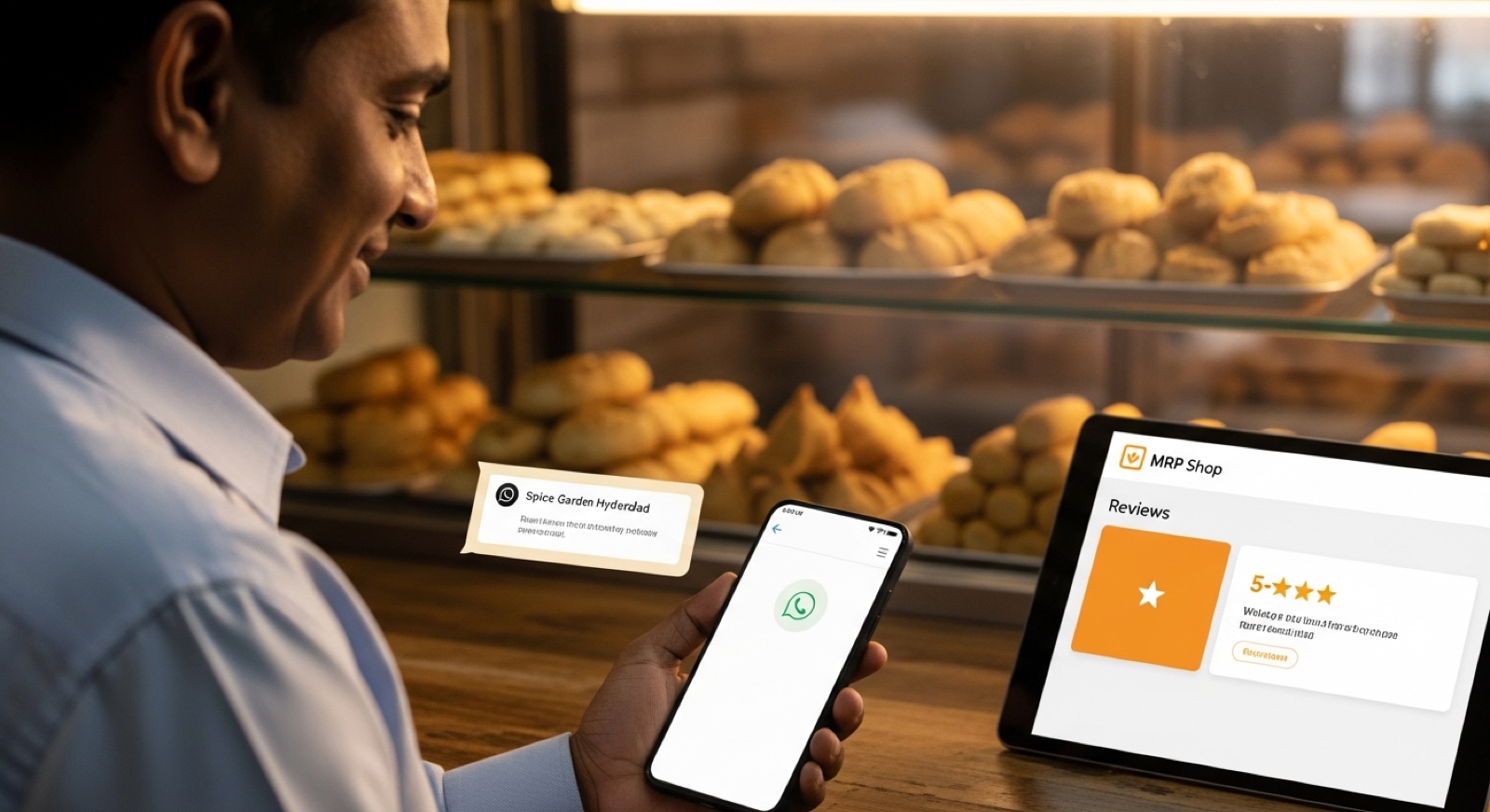
From 3.8 to 4.8 Stars: How a Bandra Bakery Boosted Google Reviews in 90 Days
By Parth · Founder, MRP Shop · Published May 16, 2026 · Updated May 16, 2026
It is 11:12am on a Saturday at a 12-seat bakery off Linking Road, Bandra. The owner - call her Farah - is staring at her Google listing on her phone between coffee orders. Stuck at 3.8 stars for seven months. Not because the food is bad. The food is good. Her almond croissants have a cult regular base. It is because the three people who got burnt bread on a rainy Tuesday in October wrote 1-star reviews, and none of the 400 happy customers since then wrote anything at all.
Ninety days later, Farah's rating was 4.8. She added 144 new reviews in that window. She did not ask a single customer out loud. Here is what actually changed.
Note: This case study is a composite based on anonymized patterns across 100+ MRP Shop restaurants in Mumbai. Names, quotes, and some specific numbers are representative, not literal - though the aggregate outcomes (3.8 to 4.8 star lift, review volume, organic walk-in compounding) match real data we see across our Bandra, Khar, and Juhu sellers.
TL;DR - A 12-seat Bandra bakery pushed its Google rating from 3.8 to 4.8 in 90 days by sending every billed customer a WhatsApp message with a one-tap Google review link, fired inside the 2-hour dopamine window after the visit. Monthly new reviews climbed from ~6 to ~48. Organic walk-ins - people finding the bakery on Google Maps - roughly doubled. Zero cash spent on ads.
Why do most Indian bakeries plateau at 3.8 stars on Google?
Most Indian bakeries plateau around 3.8 stars because happy customers forget to review while unhappy ones always remember. Negative reviews land within hours of a bad experience. Positive reviews depend on the customer remembering 48 hours later - and by then, the croissant is a blurry memory. Without a mechanism to catch happy customers in the 2-hour dopamine window, ratings naturally drift downward.
We looked at Google Maps ratings across 300+ MRP Shop restaurants in Bombay, Bangalore, and Jaipur before they joined. The median rating was 3.9. Not because the food was average - the reviews that existed were overwhelmingly positive - but because there were not enough of them. Three bad reviews against six good ones gives you a 3.8. Three bad reviews against fifty good ones gives you a 4.7.
The problem was never the quality. It was the volume.
When is the right moment to ask a customer for a Google review?
The right moment is 30 minutes to 2 hours after the customer leaves - not when she is standing at the counter paying, and not the next day. This is when the post-meal dopamine is still warm but she is no longer in your line of sight, so the review feels like a private decision, not a social favour. Reviews requested in this window convert at roughly 3-4 times the rate of reviews requested in-person.
Why not ask at the counter? Because standing there, she will say "sure, definitely" and then forget. Social pressure is a lousy motivator for something that requires phone unlocking, app switching, typing, and submitting.
Why not the next day? Because by then the almond croissant is yesterday's almond croissant, and the Tuesday work email is today's problem. The review never happens.
| Review Ask Method | Typical Conversion | Five-Star Rate | Staff Effort |
|---|---|---|---|
| At the counter, in-person | 3-5% | ~65% | High (every customer) |
| QR code on bill / table | 1-2% | ~70% | Zero |
| Email the next day | 2-3% | ~60% | Low |
| WhatsApp 2 hours after visit | 12-18% | ~75% | Zero (auto) |
| WhatsApp + Rs.30 cashback for review | 22-28% | ~70% | Zero (auto) |
The WhatsApp-plus-cashback combo wins on both conversion and zero-effort. The five-star rate dips slightly because the cashback incentive pulls in some 4-star honest reviews, but the volume lift more than makes up for it - and Google rewards volume heavily in local pack rankings.
Why does a higher Google rating compound into more walk-ins?
Google's local pack algorithm heavily favours restaurants with higher ratings and more reviews. A 4.8-rated bakery shows up 2-3 times more often in the "bakery near me" map results than a 3.8-rated bakery in the same neighbourhood. That visibility is a free acquisition channel that compounds: more walk-ins means more reviews, more reviews means more rank, more rank means more walk-ins.
Ahrefs' 2025 study of local pack rankings found that rating was the single strongest correlate with map-pack position after proximity. Proximity you cannot change (your bakery is where it is). Rating you can.
"I stopped asking customers to review me. Ab main kitchen mein wapas aa gayi. Reviews apne aap aa rahi hain."
- Farah, on Day 60
How Farah's Bandra bakery went from 3.8 to 4.8 in 90 days
Who: Farah runs a 12-seat bakery off Linking Road in Bandra West. Almond croissants, sourdough, black forest pastries, cold coffees. Two bakers, one counter person, herself on weekends. Roughly 90 walk-ins a day plus a steady Zomato and Swiggy delivery flow.
The pain: Farah's Google rating had been 3.8 for seven months. The reviews she did have were mostly glowing - "best croissants in Bandra", "Farah remembers my regular order", "worth the line on Sunday mornings". But there were only 41 of them. And three one-star reviews from customers who came in on bad days (one of them, genuinely, got burnt bread - the oven had broken that week) dragged the average down hard.
Her monthly new-review volume was roughly 6. Even on her best months.
What she tried first: A "Please review us on Google" sign at the counter. A QR code sticker on every bill. Asking politely at checkout ("ma'am, if you have 30 seconds..."). She even offered her regular weekend customers a free cold coffee for a review. All of these moved the needle by maybe one review a month - barely worth the friction.
What changed on Day 1: Farah switched on MRP Shop's auto WhatsApp review booster. Every customer whose phone went into the POS got a WhatsApp message 90 minutes after billing with one line ("Thank you for visiting [bakery name] today - we'd love a quick review, tap here") and a one-tap Google Maps review link. She also enabled a small Rs.20 cashback for any customer who left a review - positive, negative, or anything in between.
That was it. 15 minutes of setup. She then went back to making croissants.
Day 14: First visible review volume lift. 19 new reviews in the first two weeks, up from her usual ~3 in the same period. Rating had not moved yet (still 3.8 because volume was still small) but the trajectory was obvious in the dashboard.
Day 45: Rating crossed 4.1. 53 new reviews since she enabled the flow, of which 41 were 5-star, 8 were 4-star, 4 were 3-star or below. The cashback incentive had pulled in some legitimately critical reviews (one customer complained about slow service on a Sunday), which Farah actually appreciated because she fixed the Sunday staffing issue.
Day 90:
- Google rating: 3.8 → 4.8
- Total reviews: 41 → 185 (144 new in 90 days)
- Monthly new reviews: ~6 → ~48
- Organic walk-ins (Google Maps discovery): roughly 2×
- Monthly revenue: up ~22% versus the three months before
- Zomato Hygiene Rating impact: Zomato auto-synced the higher rating to her listing at ~Day 60
What is the exact WhatsApp review booster setup?
The exact setup is one MRP Shop toggle plus a small cashback incentive: enable the Google Review Booster, set the trigger window to 60-120 minutes after billing, and optionally attach a Rs.20-Rs.50 cashback per review. The flow auto-fires a WhatsApp message with a one-tap Google Maps review link. Zero staff effort, zero social awkwardness, measurable within 14 days.
- Turn on the Google Review Booster inside MRP Shop. One toggle in the seller dashboard. Connect your Google Business Profile.
- Set the trigger window to 60-120 minutes after billing. Not immediately (feels pushy), not 24 hours later (too late). The 1-2 hour window catches the dopamine.
- Use the pre-written message template. "Thank you for visiting us today - if you have 20 seconds, a quick review really helps us. [One-tap Google Maps link]." Short, no begging, no emoji wall.
- Attach a Rs.20-Rs.30 cashback for leaving any review. Not for 5-star reviews - that violates Google's terms. For any review. The review conversion roughly doubles.
- Do not respond to reviews for the first 7 days. Let volume build. After Day 7, respond to every single review - positive and negative - with a warm, specific sentence.
How should a bakery handle negative reviews without sounding defensive?
Respond publicly within 24 hours with three things: acknowledge the specific issue, name what you are fixing, and offer to make it right off-platform. Do not argue, do not explain the kitchen, and never blame the customer. Future customers read your negative reviews more than your positive ones - and they judge you by how you respond, not by the complaint itself.
Farah's example response to a 2-star review about slow service: "Ma'am, really sorry about the wait last Sunday - we had one staff member out and it clearly showed. We've added a weekend morning person since. If you come back, please ask for Farah at the counter and the coffee is on us." That response is read by every future customer considering the bakery. It is worth more than the original complaint cost.
Where does MRP Shop fit in this playbook?
We built MRP Shop's Google Review Booster around exactly this timing window and one-tap flow. It is one reason our average restaurant sees Google ratings climb from the high 3s to the mid or high 4s inside 90 days. But even if you use a different tool, the principle is what matters: catch the customer while the dopamine is still warm, make the review one tap away, and never ask for it out loud. The automation is just what makes it survivable when you have 90 walk-ins a day and one oven to watch.
Frequently Asked Questions
Why do most Indian bakeries plateau at a 3.8 Google rating?
Most Indian bakeries plateau around 3.8 because happy customers forget to review and unhappy customers always remember. Without a mechanism to catch the happy ones in the 2-hour window after a great visit, the negative reviews compound faster than the positive ones. The food is rarely the problem - the timing is.
What is the best window to request a Google review after a visit?
The 30-minute to 2-hour window after the customer leaves is when the dopamine is still warm and the review is most likely to be five stars. After 12 hours, the food has faded from memory. After 24 hours, the review rate drops by roughly 70%. WhatsApp automation lets you hit the window every single time.
How many new reviews per month does a small bakery actually need?
To climb from 3.8 to 4.8 in 90 days, a small bakery needs roughly 30 to 50 new five-star reviews per month, sustained. That is about one to two reviews per day - very achievable when every billed customer gets a one-tap WhatsApp review link, and when the flow catches them in the post-meal dopamine window.
Does paying for reviews work?
No, and Google will shadow-penalize you for it. What works is offering a small cashback (Rs.20-Rs.50) for leaving any review - honest ones, positive or negative. This complies with Google's terms because the incentive is for the review action, not the star rating. Most MRP Shop restaurants see 60-70% of these reviews land at 5 stars naturally.
How does a higher Google rating translate to more walk-ins?
A 4.8-rated bakery shows up roughly 2 to 3 times more often in Google Maps local pack results than a 3.8-rated bakery in the same neighbourhood. That means more organic discovery, more walk-ins, and more delivery orders - all without spending a rupee on paid ads. Rating is the single biggest free-acquisition lever a small restaurant has.
Three things to take home
First, your rating is not a reflection of your food - it is a reflection of your review volume. Fix the volume, fix the rating. Second, the 60-120 minute post-visit window is the single best moment in a customer's day for review conversion, and automation is the only way to hit it every time. Third, a 1-star rating bump compounds into 2-3× more organic walk-ins via Google Maps - meaning reviews are not just vanity, they are acquisition. If you want the full playbook, book a 15-minute WhatsApp demo - we will show you the review math on your own Google listing.
P.S. The single most surprising finding from Farah's 90 days was not the rating lift. It was that her Zomato delivery volume went up by roughly 18% even though she did not touch her Zomato listing - because Zomato's algorithm auto-syncs Google ratings and promotes higher-rated restaurants in search results. Fixing Google fixes Zomato too, for free.
Parth - Founder, MRP Shop. Spent the last 18 months in Indian restaurant kitchens from Jaipur to Bandra figuring out why loyalty programs keep failing. Writes about restaurant growth, WhatsApp marketing, and commission-free ordering. LinkedIn · contact@mrpshop.in
Why Indian Restaurants Pick MRP Shop
One platform. Every growth lever. Built for Indian restaurant margins.
Get the same 3.8 to 4.7 star lift for your restaurant.