
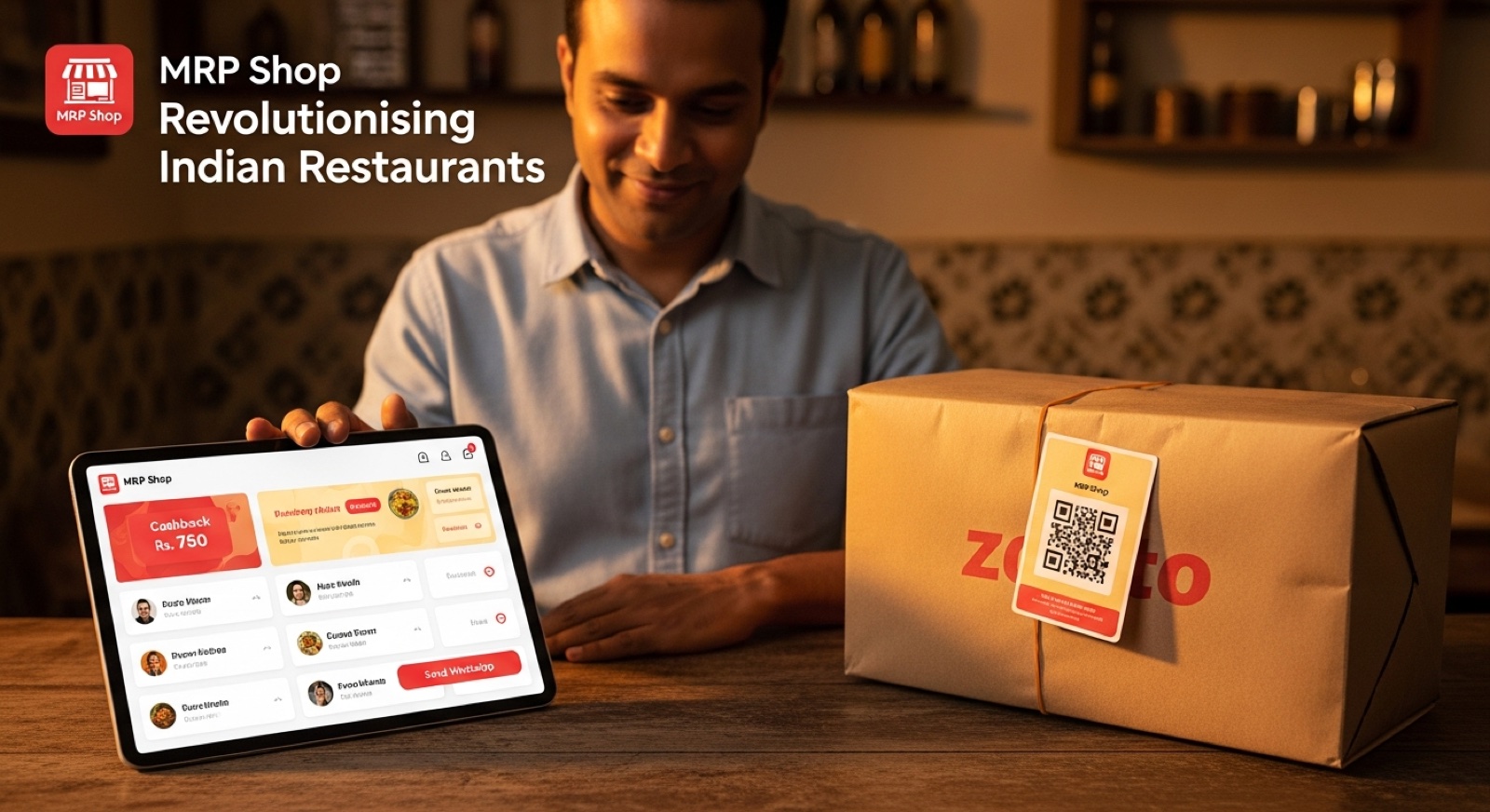
Direct Ordering vs Zomato: What's Actually Better for Indian Restaurants?
By Parth · Founder, MRP Shop · Published April 28, 2026 · Updated April 28, 2026
Rs.360 out of every Rs.1,200 Zomato order. That is your AC bill, or half a chef's daily wage, or 14 months of a good POS subscription - gone before the dosa hits the plate. But here is what nobody tells you honestly: Zomato is also the reason that first-time customer from HSR Layout even knew you existed. The question is not "quit Zomato." The question is: which job are you hiring each channel to do?
Use Zomato for discovery and direct ordering for retention. Zomato charges 25 to 30% commission and owns customer data, which makes it expensive for repeat orders - but it is still the cheapest way to find new customers. Build a direct channel (storefront + QR flyer + WhatsApp loop) so your existing customers order direct from visit two onwards. The best restaurants we see land at roughly 50 to 60% direct, 40 to 50% aggregator.
What this guide covers
- What does Zomato actually cost an Indian restaurant per order?
- Who owns the customer when an order comes through Zomato?
- How does direct ordering compare to Zomato on retention rates?
- How do you build a direct channel without losing Zomato discovery?
- How did one cloud kitchen balance both channels over 6 months?
- Frequently Asked Questions
What does Zomato actually cost an Indian restaurant per order?
Zomato costs an Indian restaurant approximately 25 to 30% commission per order in 2026, plus 1.5 to 2% in payment gateway fees. On a Rs.1,200 order, that is roughly Rs.360 in commission alone - meaning the restaurant keeps about Rs.840 before food cost, packaging, and delivery-partner fuel. NRAI's own reports put the Indian food services market at Rs.4.2 lakh crore, and a meaningful slice of that flows to aggregator commission layers.
Let us scale the math. 100 orders per month via Zomato:
- Gross order value: Rs.1,20,000
- Commission (30%): Rs.36,000
- Payment gateway (~2%): Rs.2,400
- Actual revenue to restaurant: ~Rs.81,600
- Per year at this volume: Rs.4.3L+ lost to commission alone
That Rs.4.3L figure is not theoretical - it is the authorized MRP Shop number we cite because we have seen it repeatedly in our restaurant cohort. Rs.4.3L pays a full-time cashier for a year, runs your kitchen AC for six months, or funds the entire marketing stack for 18 months with money to spare. The question is what you would do with it if you got it back.
"Bhai, Zomato se kitchen chalti hai, ghar nahi."
Who owns the customer when an order comes through Zomato?
When a customer orders through Zomato, Zomato owns the customer data - name, phone, address, order history, preferences. The restaurant gets the order ticket and the food goes out, but the relationship stays inside Zomato's wall. This is the hidden cost that most owners discover too late: you cannot run loyalty, WhatsApp followups, or Google review requests on customers you do not have contact info for.
Direct ordering flips this entirely. When the same customer orders from your branded storefront at customer.mrpshop.in/seller/[name], the phone number, address and order history all land in your own database. You can now:
- Send a WhatsApp invoice with cashback credit in 2 seconds
- Request a Google review after the meal lands
- Trigger a Day 30 drip if they do not come back
- Invite them to VIP status after Rs.10,000 in lifetime spend
- Message them for Diwali, Holi, Valentine's and every festival without asking Zomato for permission
None of these are possible via Zomato. That is not Zomato being unfair - it is Zomato's business model. The marketplace keeps the relationship. Your job, if you want retention to compound, is to move the relationship off-marketplace.
How does direct ordering compare to Zomato on retention rates?
Direct ordering wins decisively on retention because it exposes the full loyalty loop - WhatsApp invoice, cashback, Google review, drip campaigns - that aggregators structurally block. Zomato wins on initial discovery because it surfaces your listing to first-time customers who would otherwise never find you. The two channels do different jobs.
| Factor | Via Zomato/Swiggy | Via Direct (MRP Shop) |
|---|---|---|
| Commission per order | 25 - 30% (Rs.360 on Rs.1,200) | 0% |
| Customer phone number | Hidden from you | Yours |
| New-customer discovery | Strong (app-level search) | Weak (requires your marketing) |
| WhatsApp followup | Not possible | 2-second auto-send |
| Repeat cashback | None | 10% auto-credited |
| Google review request | Random | One-tap automated |
| Festival campaigns | Aggregator-controlled | Automated, your brand |
| Typical repeat rate (first 90 days) | ~15 - 22% Not disclosed in public docs | ~58%+ on MRP Shop |
The takeaway from the table: neither channel is a villain. Zomato is a paid discovery layer. Direct is a retention layer. Running only one is always worse than running both intelligently.
How do you build a direct channel without losing Zomato discovery?
You build a direct channel without losing Zomato discovery by treating Zomato as a paid customer-acquisition source and converting those customers to direct from their second order onwards. You do not leave Zomato, you layer a retention channel on top. The QR flyer in every Zomato delivery bag is the bridge between the two.
The playbook we have watched hundreds of restaurants run successfully:
- Set up a branded storefront. MRP Shop gives every seller a direct storefront at customer.mrpshop.in/seller/[name]. Add menu, offers, loyalty status.
- Print 500 QR flyers. Canva template, ~Rs.500 at Vistaprint. The QR points to your storefront.
- Drop one flyer in every Zomato delivery bag. Your staff does this at packing time. It adds zero seconds to the flow.
- Offer Rs.200 cashback on the first direct order. Enough to make the customer try direct once.
- Trigger a WhatsApp followup 48 hours after their first direct order. "Thanks for ordering direct - your Rs.200 is waiting for next time."
- Track the direct-to-aggregator ratio monthly. The goal is to move from 5% direct in month one to 40%+ direct by month six.
What the playbook does not do: ask you to fight Zomato, delist, or drop their commission tier. All of those are losing moves for a SMB restaurant. You need discovery. You just do not need to pay 30% for the same customer twice.
How did one cloud kitchen balance both channels over 6 months?
A Koramangala cloud kitchen balanced Zomato and direct ordering over 6 months by running the QR-flyer playbook consistently and letting direct orders compound. They did not quit Zomato. They shifted their revenue mix.
(composite, based on patterns from ~25 cloud kitchens on MRP Shop, not a single real kitchen)
Starting state (Month 0): 180 orders/day, 95% via Zomato/Swiggy, 5% direct (a handful of regulars who knew the number). Commission outflow: ~Rs.5.1L per month. Customer list size: essentially zero. Google reviews: 4.0 stars, random cadence.
What changed: Signed up on MRP Shop. Set up branded storefront. Printed 500 QR flyers. Dropped one in every delivery bag starting Day 1. Enabled the WhatsApp + cashback + Google review loop. Did not touch the Zomato account at all.
After 6 months:
- Direct orders: 5% → 42% of volume
- Customer list: 0 → ~1,400 phone numbers
- Google rating: 4.0 → 4.6 stars
- Commission saved (monthly): ~Rs.2.1L
- Zomato orders: held roughly flat (discovery kept working)
"Zomato ko chhoda nahi. Bas usko sirf naye customers ke liye use karte hain. Purane customers seedha humse aate hain."
Where MRP Shop fits in this picture
We built MRP Shop around this exact playbook: the branded storefront, the QR-flyer math, the WhatsApp followup timing, and the cashback loop. It is one reason our average restaurant sees its direct-order share climb from single digits to 30 to 40% within 90 to 120 days. But the principle works with any tool - if you use a different platform, the sequence above still holds. The automation is just what makes it survivable for an owner-operator who does not have time to manually track a flyer program.
Frequently Asked Questions
Should Indian restaurants stop using Zomato in 2026?
No, Indian restaurants should not stop using Zomato in 2026. Zomato is excellent for new-customer discovery - people who would never find you otherwise. The smarter move is to use Zomato for discovery and build a direct ordering channel for retention, so repeat customers come back without paying the 25 to 30% commission each time.
How much commission does Zomato charge restaurants in India?
Zomato charges Indian restaurants approximately 25 to 30% commission per order in 2026, plus payment gateway fees of 1.5 to 2%. On a Rs.1,200 order, the restaurant keeps roughly Rs.840 after Rs.360 goes to the aggregator. Commission rates vary by city, cuisine and whether you opt into Zomato Pro or premium visibility programs.
Who owns customer data when a customer orders from Zomato?
Zomato owns the customer data when a customer orders through its platform. Restaurants do not get phone numbers, email addresses or order history for Zomato-originated customers. This is why aggregator-only restaurants cannot run loyalty programs or WhatsApp campaigns directly - they have no way to reach the customer outside Zomato itself.
How long does it take to build a direct ordering channel?
Building a direct ordering channel for an Indian restaurant typically takes 1 to 2 weeks to set up (storefront, QR flyers, WhatsApp flow) and 90 to 120 days to reach meaningful volume where 30 to 40% of delivery orders come direct. The first direct repeat customer usually lands within 10 to 14 days of dropping QR flyers into Zomato delivery bags.
What is the best split between direct orders and Zomato for a restaurant?
The best split depends on stage, but the healthiest pattern we see is roughly 50 to 60% direct and 40 to 50% aggregator for a mature direct channel. New restaurants start at 5 to 10% direct and compound over 6 months. The goal is never 100% direct - it is to stop depending on Zomato for the customers you already have.
Conclusion
Three things to take home. First, Zomato and direct ordering are not a binary choice - they do different jobs, and mature restaurants use both. Second, the real cost of Zomato-only is not the 30% commission, it is the fact that you never own the customer and cannot run loyalty, reviews or retention loops. Third, the playbook to shift the mix is simple: branded storefront, QR flyer in every delivery bag, cashback on first direct order, WhatsApp followup. Compounds over 90 to 120 days.
Next read: manual vs automated restaurant marketing and best restaurant marketing platforms in India (2026).
P.S. The highest-ROI one-time move we have ever seen a restaurant make is dropping one QR flyer into every Zomato delivery bag for 90 straight days. No software, no consultant, no meetings. Just one sheet of paper in every bag. The rest of the loop just makes sure the converted customers keep coming back.
Why Indian Restaurants Pick MRP Shop
One platform. Every growth lever. Built for Indian restaurant margins.
Launch your own direct ordering storefront with MRP Shop.