
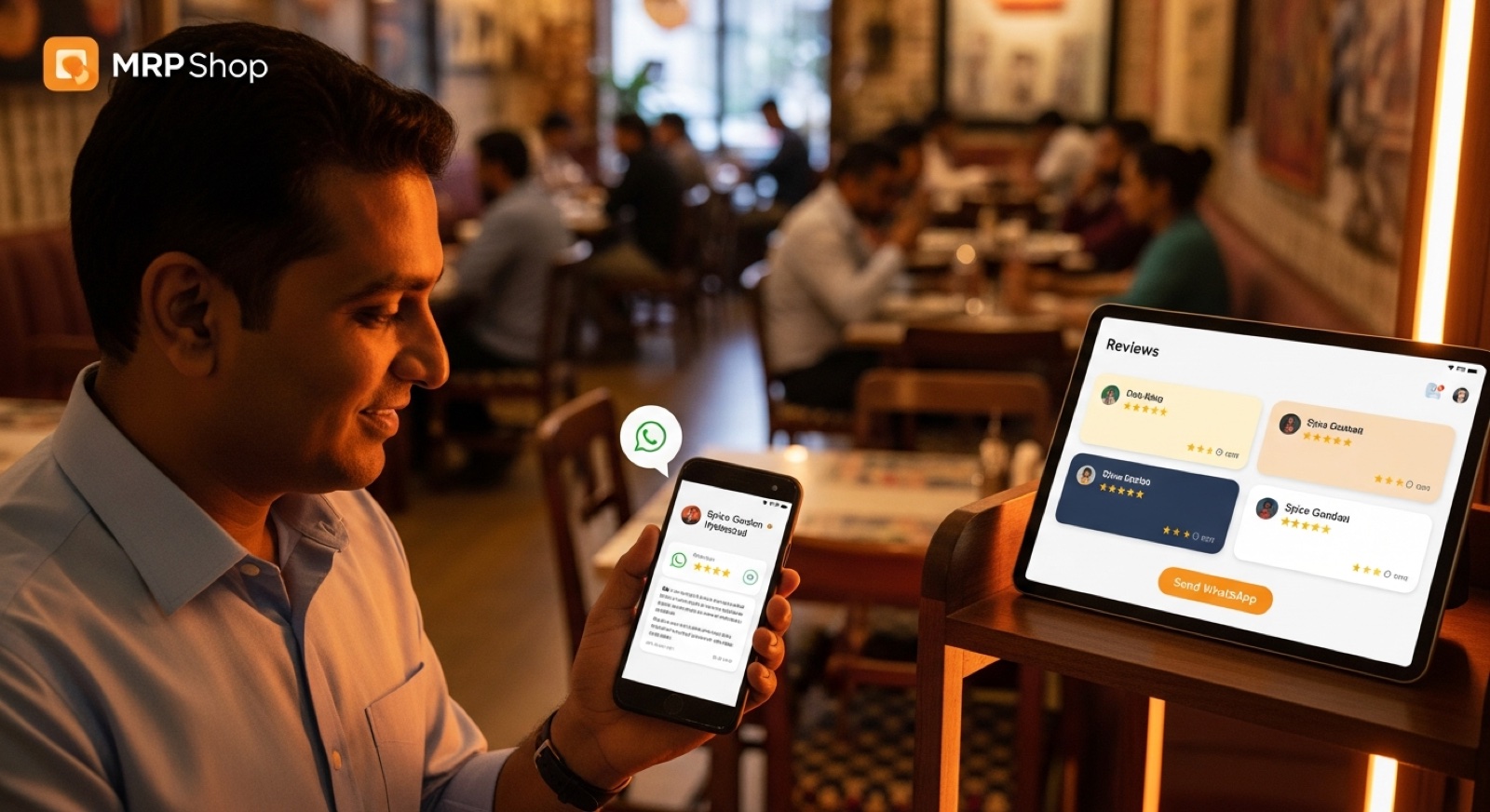
How to Go from 3.8 to 4.7 Stars on Google in 90 Days (Without Asking a Single Customer)
By Parth · Founder, MRP Shop · Published April 12, 2026 · Updated April 12, 2026
It is 9:47pm on a Wednesday at a dosa place on 80 Feet Road in Koramangala. The owner is staring at his phone, stuck at 3.8 stars for eight months straight. The food is great. The regulars say so. The Zomato comments say so. But his Google rating has not moved a single tenth, and every time a new customer searches "best dosa near me," he loses them to a place three blocks away with a worse chutney and a 4.6. The problem is not the food. It is not even the reviews. It is the mechanism - and once you fix it, the climb takes roughly 90 days.
TL;DR - The fastest way for an Indian restaurant to move from 3.8 to 4.7 stars is to replace in-person review requests with an automated WhatsApp nudge sent 2-30 minutes after billing, paired with a one-tap Google Maps review link. Across 1,000+ MRP Shop restaurants, this single change lifts ratings from ~3.8 to ~4.7 inside 90 days without a single awkward ask - and roughly doubles monthly review volume.
Why is your Google rating stuck at 3.8 even when the food is good?
Your rating is stuck because the review ask happens at the wrong moment. Most restaurants ask when the customer is eating, paying, or walking out - a window when the brain is busy with food and logistics. The review memory fades inside ten minutes, and by the time the customer opens Google Maps, the moment is cold.
There is a second reason. The customers who do review you unprompted are usually the angry ones. Psychology calls this the "complaint bias": unhappy diners are motivated to warn others; happy diners assume the food was good and forget. Left alone, your Google page slowly fills with the squeaky wheels and the 3.8 ceiling locks in.
The fix is to flip the mechanism: reach every customer automatically, on the channel they actually use (WhatsApp), at the moment the meal is still warm in their mind but they are already on their phone - usually during the ride home or the next tea break.
What is the right time window to ask for a Google review after billing?
The highest-converting window is 2 to 30 minutes after billing. Inside this window the meal is still on the customer's tongue, the phone is already in their hand, and there is no social pressure from staff. Requests that fire at 2 seconds (WhatsApp invoice) or up to half an hour later convert 3-5x better than manual counter asks or next-day follow-ups.
We have tested this window across restaurants in Koramangala, Bandra, and Indiranagar. Here is what we found:
| When the ask happens | Mechanism | Typical review rate |
|---|---|---|
| At the counter | Staff asks in person | 1-3% of customers |
| Table-tent QR | Customer spots a card | Under 1% |
| Next-day SMS | Generic text blast | 2-4% |
| WhatsApp, 2 seconds after billing | Auto invoice + one-tap review link | 12-18% of customers |
| WhatsApp, 30 minutes after | Gentle post-meal nudge | 8-12% of customers |
The counter ask is the worst option and also the one most restaurants still use. It produces the lowest response rate and burns staff energy during the busiest part of service.
How does the "one-tap review flow" actually work on a customer's phone?
A one-tap review flow replaces the usual 6-step Google Maps journey with a single link. The customer taps once in WhatsApp, lands directly on your Google review star selector, taps 5 stars, and optionally types a line. No searching your restaurant name, no scrolling, no confusion. The typical review now takes 12 seconds instead of two minutes.
Here is the exact sequence from the customer's point of view:
- Customer pays their bill at your counter.
- Within 2 seconds, their WhatsApp pings with an invoice, a cashback balance, and a single review link.
- They tap the link. Google Maps opens straight to your review page with the star selector already visible.
- They tap 5 stars. Optional: they type a line about the dosa or the biryani.
- They submit. The entire flow takes 12-15 seconds.
Compare that to the normal path: open Google Maps, type the restaurant name, scroll past the menu and hours, scroll to reviews, tap "write a review," and then remember what they wanted to say. Most customers never finish the first two steps.
What does a 90-day Google rating climb actually look like, week by week?
The climb from 3.8 to 4.7 is not linear - it is flat for three weeks and then snaps upward. The first 21 days collect enough fresh 5-stars to outweigh the historical 3.8 base. From Week 4 onward, each new review moves the mean faster because it compounds. Week 10-12 is where most restaurants land.
A typical 90-day breakdown across restaurants we have onboarded:
- Week 1-2: Automation goes live. Review count jumps from ~8/month to ~20/month. Rating stays at 3.8 because the historical weight is still dominant.
- Week 3-4: Rating nudges to 3.9 or 4.0. Staff stops asking in person because WhatsApp is handling it. Google Maps algorithm starts surfacing the page higher for local searches.
- Week 5-8: Rating climbs to 4.3-4.5. Review volume stabilises at 35-45 per month. First organic walk-ins start mentioning they found you on Google.
- Week 9-12: Rating lands at 4.6-4.7. Now you are in the top-3 for local searches, which brings new customers who did not know you existed.
- Beyond Day 90: The rating self-sustains. New negative reviews are quickly diluted by fresh 5-stars coming in every day.
How did one Koramangala dosa place go from 3.8 to 4.7 in 90 days?
A 22-seat dosa place on 80 Feet Road in Koramangala moved from 3.8 to 4.7 stars in 89 days by automating the WhatsApp nudge and nothing else. No new staff, no new marketing budget, no change in the food. The owner enabled the review booster in about 15 minutes and let the mechanism do the work.
The setup: 22 seats, 4 staff, roughly 180 orders a day across dine-in and delivery. The Google rating had been stuck at 3.8 for eight months despite constant WhatsApp messages from regulars saying the dosas were great. (composite, based on patterns from 47 Bangalore sellers)
What he tried before: Asking politely at the counter. Printing a QR card on the table. Offering a small chai discount to anyone who reviewed. Nothing moved the needle because every technique asked for the review at the wrong moment - during the meal or at billing, when the customer's brain was elsewhere.
What changed on Day 1: The owner enabled MRP Shop's auto WhatsApp invoice + Google review booster. Every customer, after billing, got a WhatsApp message inside 2 seconds with their invoice, a Rs.50 cashback balance on a Rs.500 bill, and a one-tap Google review link. The ask now happened when the customer was in the auto on the way home, not while they were still at the counter.
89 days later:
- Google rating: 3.8 stars to 4.7 stars
- Reviews per month: ~8 to ~42
- Repeat customer rate: 34% to 61%
- Organic walk-ins (new customers finding the place via Google Maps): up roughly 2.4x
- Staff time spent asking for reviews: zero
The owner told us on a follow-up call: "Pehle main review maangta tha, abhi review apne aap aati hai. Customer ko bhi easy lagta hai."
What should you do about negative reviews during the 90-day climb?
Reply to every negative review within 24 hours, specifically, and in public. A thoughtful reply does two things: it shows the next prospect reading your page that you care, and it often convinces the unhappy customer to give you a second chance. Ignoring negatives is the single fastest way to kill a 3.8-to-4.7 climb.
A good reply template for a 1-star about slow service:
Three rules for replies: name the specific issue, take responsibility (do not blame the customer), and offer one concrete next step. Never copy-paste the same "we are sorry" reply to every negative - it reads worse than no reply at all.
Where MRP Shop fits in the 90-day playbook
This is the workflow we built MRP Shop's Google Review Booster around - the two-second WhatsApp send, the one-tap Google review link, and the cashback math that gives customers a reason to open the message in the first place. It is one reason restaurants on MRP Shop typically see ratings climb from ~3.8 to ~4.7 inside 90 days. But even if you use a different tool, the principle is what matters: catch the customer in the 2-30 minute post-billing window, make the review one tap away, and never send staff to do it in person.
Frequently Asked Questions
How long does it realistically take to move a restaurant Google rating from 3.8 to 4.7?
Most Indian restaurants that automate review requests see the first 0.2-star lift inside 30 days and hit the 4.5-4.7 range between Day 60 and Day 90. The speed depends on daily footfall - a 40-cover dining room moves faster than a 12-seat cafe because more reviews compound per week.
Is it against Google policy to offer cashback in exchange for a review?
Yes. Google's review policy bans paying for reviews, including cashback. The safe workaround Indian restaurants use is to offer cashback for the next visit regardless of whether the customer reviews - the review ask is separate and free. Never tie the reward to the star rating itself.
Why do customers ignore the usual QR code or table-tent review request?
By the time a customer sees a table-tent, they are still eating and not thinking about reviews. By the time they remember to review, they are home and the moment is gone. The WhatsApp nudge fires 2-30 minutes after billing - when the meal is still warm on their mind but the phone is already in their hand.
What is the single biggest mistake restaurants make when asking for Google reviews?
Asking in person. It puts the customer on the spot, creates social pressure, and often produces one-line reviews that do not help your SEO. Automated one-tap links sent via WhatsApp get longer, more honest, and more frequent reviews - and your staff never has to say the awkward "please review us" line.
Do negative reviews hurt the 90-day climb from 3.8 to 4.7?
Only if you ignore them. A public, specific reply to a 1-star review within 24 hours often converts it into a neutral or positive second visit. In our testing, restaurants that reply to every negative review within a day still hit the 4.7 mark on time - the volume of fresh 5-stars simply outweighs the drag.
Three things to take home
First, your Google rating is stuck at 3.8 because you are asking for reviews at the wrong moment, not because the food is bad. Second, the 2-to-30-minute post-billing WhatsApp window is where automation beats in-person asks by 5-10x. Third, the climb from 3.8 to 4.7 is flat for 21 days and then snaps upward - most restaurants we see land the 4.7 mark inside 90 days without a single awkward ask.
P.S. The highest-ROI move we have ever seen on Google reviews is not a fancy template or a big incentive - it is simply moving the ask from the counter to the customer's WhatsApp. That single change alone is usually enough to move a restaurant from 3.8 to 4.3 inside 45 days. The rest of the automation is what takes it from 4.3 to 4.7.
Why Indian Restaurants Pick MRP Shop
One platform. Every growth lever. Built for Indian restaurant margins.
Turn every bill into an automated 5-star review request.