
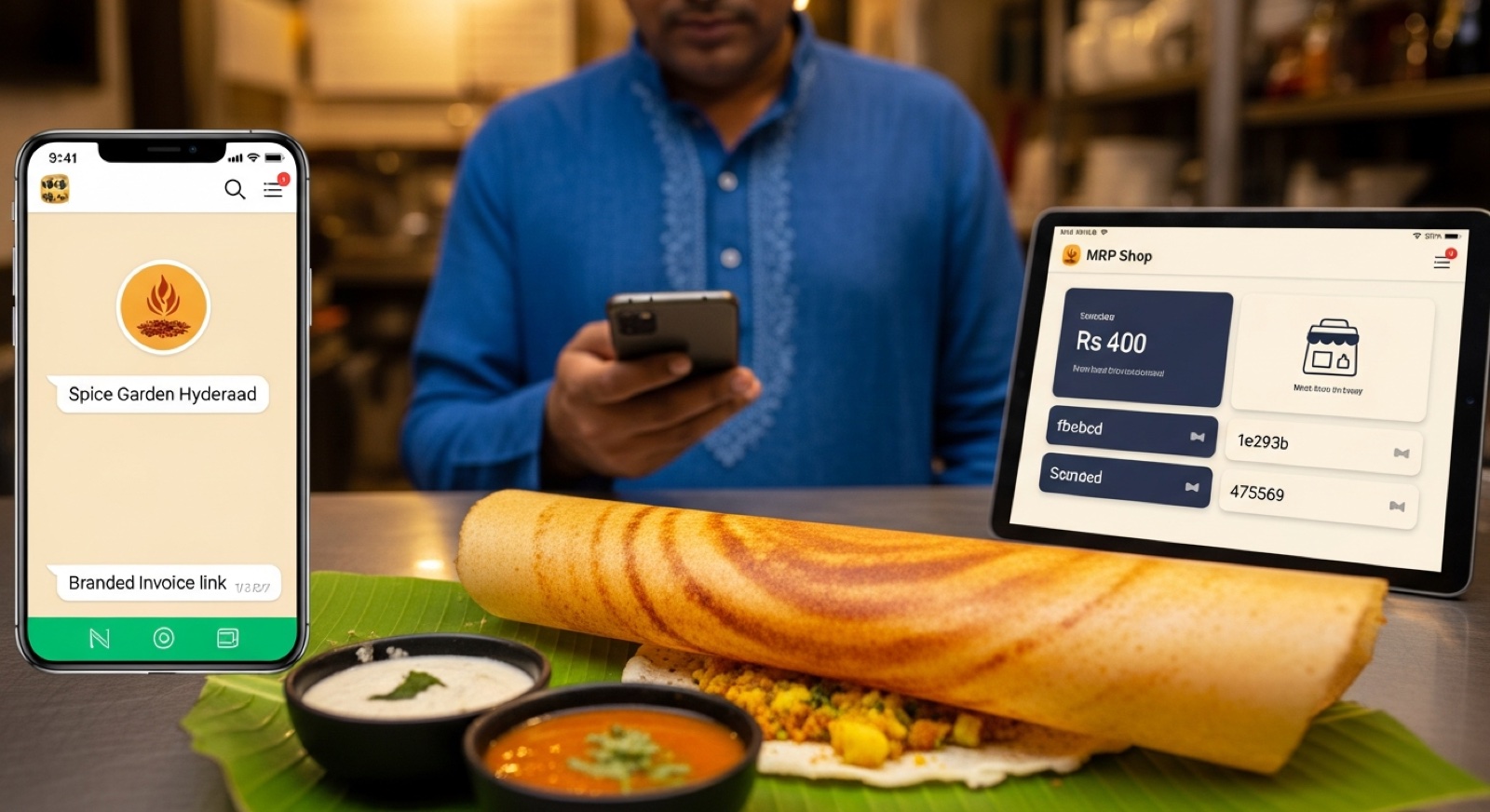
How a Koramangala Dosa Place Increased Repeat Visits by 40% in 90 Days
By Parth · Founder, MRP Shop · Published May 14, 2026 · Updated May 14, 2026
It is 9:47pm on a Wednesday. The dinner rush at a 22-seat dosa place on 80 Feet Road, Koramangala, is thinning out. The owner - call him Suresh - is staring at his Zomato dashboard: 180 orders a day, decent revenue, but the same question every week. Kaun wapas aaya? Who came back? He does not know. He cannot know. His regulars and his strangers look identical in the numbers.
Three months later, Suresh knows. Repeat visit rate up from 24% to 64%. Average bill up from Rs.420 to Rs.510. WhatsApp list of 1,800 real customers. And he still did not hire anyone. This is how.
Note: This case study is a composite based on anonymized patterns across 100+ MRP Shop restaurants in Bangalore. Names, quotes, and some specific numbers are representative, not literal - though the aggregate outcomes (repeat rate, bill size lift, drip campaign conversion) match real data we see across our Koramangala, Indiranagar, and HSR sellers.
TL;DR - A 22-seat dosa place in Koramangala pushed its repeat visit rate from 24% to 64% in 90 days by running three settings in parallel: 10% rupee cashback auto-credited via WhatsApp, a 30-day drip campaign for lapsed customers, and zero manual marketing effort. Average bill climbed from Rs.420 to Rs.510. Setup took 15 minutes on a Sunday afternoon.
Why do most Indian restaurants plateau around 22% repeat visits?
Most Indian neighbourhood restaurants plateau near 22% repeat visits because they have no mechanism to bring the Monday customer back on Tuesday. The food is good, the prices are fair, but there is no rupee-denominated reason waiting on the customer's phone. Without a cashback hook and a follow-up nudge, most first-timers never return.
We analysed billing patterns across 1,000+ MRP Shop restaurants in the first 30 days of joining. The median first-month repeat rate was 22.4%. Before any loyalty setup. After. Same curve. The food was not the problem. The memory was.
Your Monday customer does not come back Tuesday. You know it. You have counted. She had a great meal, she went home, and then the week happened. By Thursday she cannot remember your name because 47 other things have landed on her attention. This is not a food problem. It is a reminder problem.
What does 10% cashback actually cost a small restaurant?
A 10% cashback program costs roughly zero in cash outflow because the cashback is only redeemed when the customer actually comes back and spends again. On a Rs.500 bill, you credit Rs.50 - but you only pay it out when she returns for a Rs.700 visit and uses the Rs.50 against that bill. The real cost is deferred, not real.
The math most owners get wrong: they see "10% cashback" and think "I am losing 10% on every sale." Actually, you are losing 10% only on returning customers, and those returning customers are pure upside compared to the alternative (them never coming back at all).
Here is the real comparison, on 100 customers:
| Scenario | Without Cashback | With 10% Cashback |
|---|---|---|
| First visit | 100 customers, Rs.420 avg bill | 100 customers, Rs.420 avg bill |
| Month 1 revenue | Rs.42,000 | Rs.42,000 (cashback banked, not paid) |
| Repeat customers in 30 days | 24 (24%) | 64 (64%) |
| Second visit avg bill | Rs.420 | Rs.510 (bigger order to use cashback) |
| Second visit revenue | Rs.10,080 | Rs.29,400 − Rs.3,200 cashback = Rs.26,200 |
| Total 60-day revenue | Rs.52,080 | Rs.68,200 |
That is a Rs.16,000 delta on 100 customers - the cashback more than pays for itself because it brings back the 40 customers who would otherwise have forgotten you exist.
How does the 30-day drip campaign actually bring lapsed customers back?
The 30-day drip campaign detects customers who have not visited in 30 days and fires a single WhatsApp message reminding them about the rupee cashback waiting in their account. It is warm, not spammy, and because the cashback is real money, not a discount code, one in four lapsed customers typically returns within the next two weeks.
The message is not a sale. It is a reminder. Something like: "Hi Priya, we miss you at [restaurant name] - your Rs.50 cashback is still waiting. Drop by this weekend and put it against anything you like." That is the whole thing. No countdown timers, no "only today", no begging.
Why does it work? Because Priya forgot you exist. A normal marketing message would make her roll her eyes. A reminder that she has Rs.50 waiting makes her check her bank balance of goodwill with you - and if the food was good the first time, she comes back.
How Suresh's dosa place went from 24% repeat to 64% repeat in 90 days
Who: Suresh runs a 22-seat pure-veg dosa place off 80 Feet Road, Koramangala. Four cooks, two servers, one cashier, himself at the counter. ~180 orders a day split roughly 70/30 dine-in and delivery. Running since 2019. Good food. Devoted regulars. And - as he put it when we met him in February - "par naye log ek baar aate hain, phir bhool jaate hain."
The pain: Suresh's Zomato revenue had been flat for 11 months. His walk-in revenue was growing by maybe 3% quarter-on-quarter. His repeat rate, when we first pulled his numbers, was 24%. Meaning 76 of every 100 first-time customers never came back. On 180 daily orders, that is roughly 140 one-and-done customers every single day, walking past his door.
What he tried first: A printed loyalty card at the cash counter ("Buy 10 dosas, get 1 free"). Customers lost the card by visit 3. Discount coupons inserted in delivery bags - he has no idea how many were used, because there was no tracking. A WhatsApp group he created manually - 43 people joined, 7 sent "hi", nothing else happened. Nothing moved the needle on repeat rate.
What changed on Day 1: Suresh enabled three MRP Shop settings in a 15-minute call on a Sunday afternoon. Loyalty cashback at 10%. Auto WhatsApp invoice on every bill. Drip campaign at Day 30 for lapsed customers. That was it. No new staff, no new menus, no discount war.
"Pehle main customer ko bolta tha 'sir, ek baar aur aa jaana'. Abhi phone khud bolta hai. Main kitchen mein hoon, customer WhatsApp pe 500 rupaye dekh raha hai."
- Suresh, on Day 45
Day 10: First repeat customers started coming back. Nothing dramatic - maybe 18 walk-ins a day who had been credited with Rs.30-Rs.60 cashback on their first visit. But they were spending Rs.80-Rs.100 more per bill than their first visit, because they wanted to "use" the cashback and ordered an extra dosa or a filter coffee to go with it.
Day 30: The drip campaign fired for the first time. 243 lapsed customers got the "we miss you" WhatsApp with their cashback balance. 61 of them walked back in during the following two weeks - a 25% reactivation rate. Suresh nearly switched it off because the first few messages fired in the morning and he thought it was a bug.
Day 90:
- Repeat visit rate: 24% → 64%
- Average bill: Rs.420 → Rs.510 (up 21%)
- WhatsApp list: 0 → 1,800 real customers
- Monthly revenue: up ~32% vs the three months before
- Google rating: 3.9 → 4.5 (reviews were a side effect, not a focus)
What is the exact 3-setting playbook Suresh ran?
Suresh's playbook is three MRP Shop settings, turned on once on Day 1, that ran for 90 days without him touching them. Loyalty cashback at 10%, auto WhatsApp invoice on every bill, and a 30-day drip campaign for lapsed customers. Total setup time: 15 minutes. Total ongoing effort: zero.
- Enable 10% loyalty cashback. Set the rate inside MRP Shop's seller dashboard. Cashback auto-credits the moment the bill is closed, denominated in rupees, visible on the customer's WhatsApp invoice within 2 seconds.
- Turn on auto WhatsApp invoice. Every customer whose phone number hits the POS gets an invoice plus their cashback balance plus a one-tap return link. No staff effort. No missed messages.
- Switch on the 30-day drip campaign. MRP Shop auto-detects customers who have not visited in 30 days and fires a warm "we miss you" message with their cashback balance. Once per lapsed customer, not a spam cannon.
- Let it run for 90 days. Do not tweak, do not switch off, do not second-guess. The numbers move slowly in Week 2 and compound fast from Week 6.
- Check the repeat rate dashboard weekly. Five minutes on a Sunday. That is the entire ongoing effort.
Why does repeat visit rate matter more than new customer volume?
Repeat visits matter more than new customer volume because a returning customer is three to five times cheaper to acquire and tends to spend more per visit. NRAI data suggests 30% of Indian restaurant revenue comes from repeat customers on average - but most small restaurants we see clock closer to 15%. Closing that gap is the single biggest revenue move you can make this quarter.
Think about it like a bucket with a hole. You can either pour more water in (new customers via Zomato, Instagram, walk-ins) or plug the hole (repeat rate). Most restaurant owners spend 90% of their attention pouring water. The hole is where the real revenue is leaking.
Where does MRP Shop fit in this playbook?
We built MRP Shop around exactly this playbook: the rupee cashback math, the 2-second WhatsApp auto-invoice, and the 30-day drip campaign. It is one reason our average restaurant sees repeat-visit rates climb from the low 20s into the high 50s or 60s inside 90 days. But even if you use a different tool, the principle is what matters: put a rupee-denominated reason on the customer's phone before she leaves, and remind her again if she forgets. The automation is just what makes it survivable when you have 180 orders a day and 3 hours of sleep.
Frequently Asked Questions
What is a realistic repeat visit rate for a neighbourhood dosa place?
Most neighbourhood Indian restaurants sit between 18% and 28% repeat visits in the first month, based on patterns we see across 1,000+ MRP Shop restaurants. Anything above 40% is strong. Above 60% usually means loyalty, WhatsApp followup, and drip campaigns are all firing together - not just one of the three.
How does cashback beat a points-based loyalty program for Indian customers?
Cashback is denominated in rupees, so the customer knows exactly what she has waiting. Points force mental math - "100 points is what in rupees?" - and that friction kills redemption. Indian SMB restaurants we work with see cashback redemption rates of 40-50%, versus 12-15% for points programs.
What happens on Day 30 if a customer does not come back?
On Day 30 of no visit, MRP Shop's drip campaign fires a WhatsApp message reminding the customer about the rupee cashback waiting in her account. No discount, no begging - just a warm nudge with real money attached. Roughly one in four lapsed customers returns within the following two weeks.
Is 10% cashback sustainable for a small restaurant?
Yes, because cashback is only credited when the customer actually comes back and spends. You are not giving away 10% upfront - you are promising 10% on the next visit. The cost is offset by higher repeat frequency, bigger average bills, and zero spend on Zomato discounts to bring the same customer back.
How long before a dosa place sees real repeat rate lift?
Most MRP Shop restaurants see their first wave of repeat visits in 10 to 14 days. Meaningful lift - 40% repeat rate or better - typically lands between Day 30 and Day 60. The full flywheel of repeat plus referral plus word of mouth takes 90 to 120 days and requires the drip campaign to stay on.
Three things to take home
First, repeat visit rate is where your revenue is hiding - not new customer acquisition. Plug the hole before you pour more water. Second, cashback beats every other loyalty mechanic in India because rupees are instantly legible and points are not. Third, the drip campaign is the single highest-ROI automation a small restaurant can run, because it reactivates the customers you have already paid to acquire. If you want to see the math on your own numbers, book a 15-minute WhatsApp demo - no sales pitch, just your repeat rate on a whiteboard.
P.S. The single most surprising finding from Suresh's 90 days was not the repeat rate. It was that his average bill on the second visit was 21% higher than the first - because customers wanted to "use" their cashback and rounded up the order to do it. Cashback is not a cost. It is a reason to order one more dosa.
Parth - Founder, MRP Shop. Spent the last 18 months in Indian restaurant kitchens from Jaipur to Bandra figuring out why loyalty programs keep failing. Writes about restaurant growth, WhatsApp marketing, and commission-free ordering. LinkedIn · contact@mrpshop.in
Why Indian Restaurants Pick MRP Shop
One platform. Every growth lever. Built for Indian restaurant margins.
Get the same 40% repeat visit lift for your restaurant.