
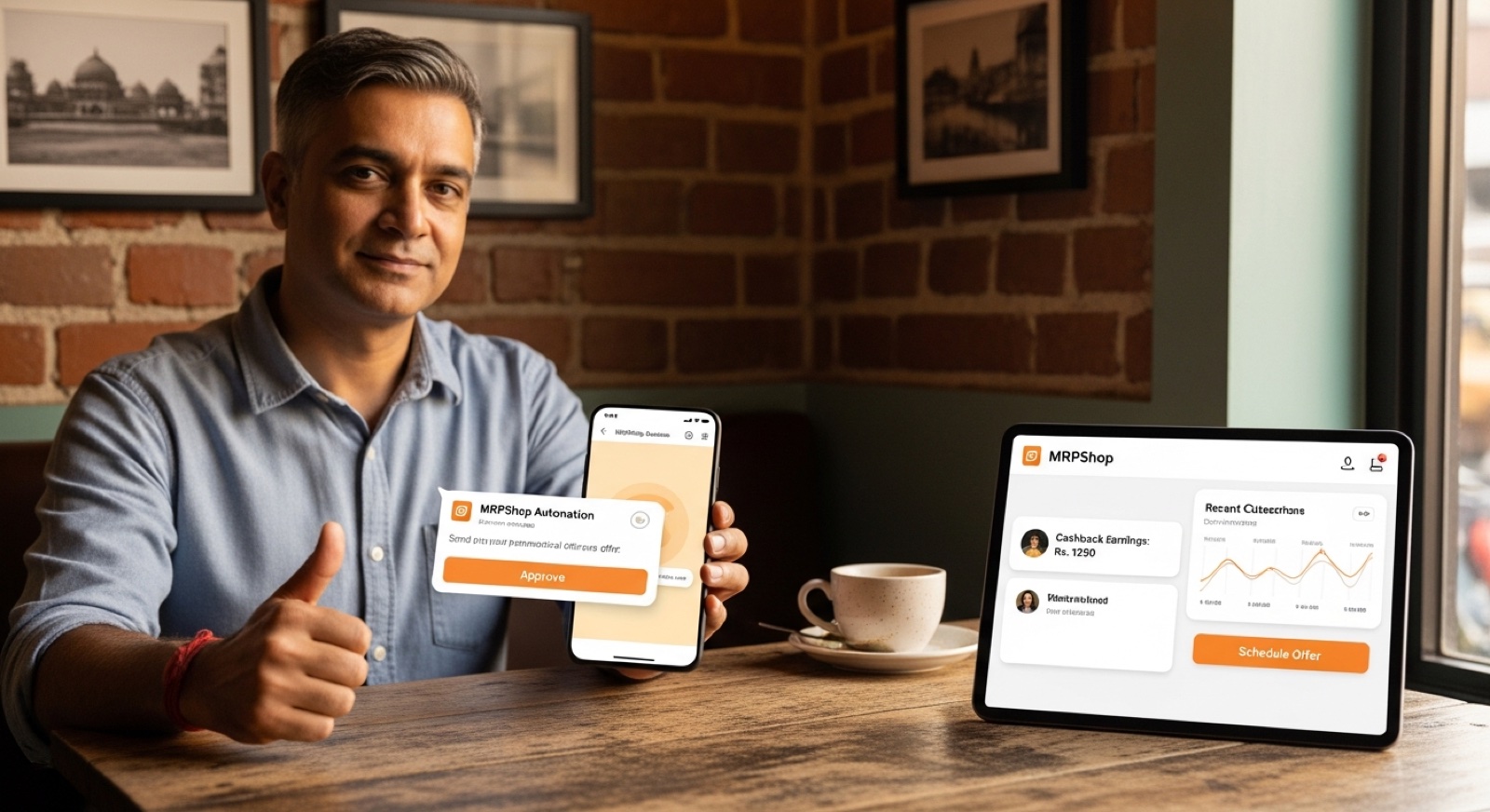
Manual Restaurant Marketing vs Automation: What It Actually Costs You
By Parth · Founder, MRP Shop · Published April 26, 2026 · Updated April 26, 2026
One hour per campaign. Four campaigns a month. That is half your Sunday - and that is assuming you actually ship every campaign, which almost nobody does. A Bandra bakery owner told us last December: "Promos ka time hi nahi milta, bhaisaab. Main sochta rehta hoon, bhejta nahi." The real cost of manual restaurant marketing is not the hour. It is the campaigns you plan and never send. Let us put rupees on both.
Manual restaurant marketing costs a typical Indian SMB restaurant 30 to 45 hours per month and, more importantly, an estimated 60% of campaigns that get planned but never sent. Automation removes both - the hours and the discipline tax. In our experience across 1,000+ MRP Shop restaurants, automation usually pays for itself inside the first month just through recovered festival batches.
What this guide covers
- How many hours does manual restaurant marketing really take?
- What is the hidden cost of campaigns you plan but never send?
- What does the manual vs automation hour comparison look like?
- How does a typical Indian cafe switch from manual to automated in one afternoon?
- What should you never automate?
- Frequently Asked Questions
How many hours does manual restaurant marketing really take?
Manual restaurant marketing takes a typical single-outlet Indian restaurant 30 to 45 hours per month when you count WhatsApp broadcasts, festival promos, review chasing, drip followups and basic loyalty tracking. That is a full working week every month - on top of actually running the kitchen, managing staff and handling customer complaints.
We tracked this informally with a handful of Jaipur and Koramangala restaurants before they joined MRP Shop. Here is what a week looked like for one of them Not disclosed in public docs:
- WhatsApp broadcast to 400 customers (one campaign): ~1 hour - copy, media, forwarding in batches, checking for delivery failures
- Google review requests (20 customers manually): ~30 minutes - scrolling through the day's bills, typing individual messages
- Festival promo design and send (Diwali, Holi, etc.): ~2 to 3 hours - Canva, translation, batch sending
- Drip to lapsed customers (Day 30+): ~1 hour - identifying lapsed, drafting, sending
- Loyalty balance tracking on a spreadsheet: ~30 minutes per week
Multiply by four weeks, add a festival or two, and you are looking at 35+ hours. Most owner-operators simply skip the work. They do not see it as "lost marketing" - they see it as "I did not have time today."
What is the hidden cost of campaigns you plan but never send?
The hidden cost of unsent restaurant marketing campaigns is the repeat revenue that never shows up. When you plan a Diwali push, do not ship it, and 200 of your customers order from someone else's WhatsApp instead, the loss is not theoretical - it is the Rs.8,000 orders those 200 customers would have placed had you nudged them.
We see this pattern constantly. An owner tells us: "I planned to send a Holi offer, but dinner rush happened, then the fridge broke, then my son had exams." All three reasons are legitimate. All three reasons guaranteed the offer never went. And the customer who was waiting for a nudge to come back did not come back.
"Main to WhatsApp bhejta hoon, par koi padhta hi nahi - asli problem yeh hai ki main bhejta hi nahi."
In our experience across 1,000+ MRP Shop restaurants, the biggest improvement in month one is not "better copy" - it is "actually sending the campaigns at all." Automation removes the discipline tax. The Diwali batch fires at 9am on Diwali morning whether the owner is free or not.
What does the manual vs automation hour comparison look like?
Manual marketing consumes 30 to 45 owner-operator hours per month across routine tasks. Automation drops that to under 2 hours - and more importantly, ensures nothing gets skipped. The table below puts the two side by side for a typical 400-customer Indian restaurant.
| Task | Manual (per month) | Automated (per month) | Time Saved |
|---|---|---|---|
| Invoice delivery to 400 customers | ~6 hours | 0 hours (2-sec auto-send) | ~6 hours |
| Google review requests | ~8 hours | 0 hours (post-bill auto-nudge) | ~8 hours |
| 4 weekly WhatsApp broadcasts | ~4 hours | ~30 min (set schedule) | ~3.5 hours |
| 1 festival campaign | ~3 hours | ~10 min (pick template) | ~2.8 hours |
| Day-30 lapsed drip | ~4 hours | 0 hours (auto-trigger) | ~4 hours |
| Loyalty balance tracking | ~2 hours | 0 hours (auto-credit) | ~2 hours |
| Total | ~27 hours | ~40 min | ~26+ hours |
26 hours per month. At a conservative valuation of owner-operator time at Rs.500 per hour (which is low - most owners say their "real" hourly value is closer to Rs.1,000 during dinner rush), that is Rs.13,000 per month in recoverable time alone. Before counting the revenue lift from campaigns that now actually ship.
The most valuable hour automation gives you back is not a marketing hour - it is the hour you reclaim from standing at the counter typing the same WhatsApp invoice 40 times a day. That hour goes straight back to the kitchen, which is where every owner-operator should be.
How does a typical Indian cafe switch from manual to automated in one afternoon?
A typical Indian cafe switches from manual to automated restaurant marketing in one afternoon by following four steps: connect the POS, set the cashback rate, enable the Google review booster, and pick a festival template library. All four take under an hour combined on a modern platform like MRP Shop.
Here is the actual sequence a Koramangala cafe ran last month (composite, based on a typical onboarding pattern):
- 3:45pm - signed up, entered restaurant name and basic branding
- 3:55pm - connected Petpooja POS (1-click OAuth)
- 4:05pm - set cashback at 10% and enabled auto WhatsApp invoice
- 4:10pm - enabled Google review booster (post-bill one-tap nudge)
- 4:15pm - turned on Day-30 lapsed drip
- 4:25pm - ran the first test bill. WhatsApp invoice landed on customer's phone in 2 seconds.
- 4:30pm - went back to the kitchen and did not touch the app again that week
45 minutes to flip from "I spend my Sundays doing marketing" to "marketing runs itself." The cafe owner told us a week later the most surprising part was not the automation - it was how much emotional weight she did not realise she had been carrying around unsent campaigns.
What should you never automate?
You should never automate genuine human touchpoints: replies to customer complaints, one-on-one birthday wishes for your top 20 VIPs, and the hand-written thank-you when a regular brings a friend. Automation handles the scaffolding; the human moments still need the owner. Otherwise, customers start to feel like rows in a database.
- Complaint replies - auto-responses to angry customers feel dismissive. Handle these yourself, fast.
- VIP birthday messages - personalise your top 20 customers manually. The other 200, let automation handle.
- Incident-specific apologies - never batch-send an apology for a one-off kitchen error.
- New menu launches - send a manual WhatsApp to your 30 best customers before the auto-broadcast goes to the full list. Makes them feel in-the-know.
The rule: automate the repeatable, personalise the rare. That is where trust comes from.
Where MRP Shop fits in this picture
We built MRP Shop specifically for the "I keep meaning to send it but I never do" problem. The auto WhatsApp invoice, cashback credit, Google review nudge and Day-30 drip all fire automatically after billing, so the owner-operator gets the outcome without the Sunday tax. You can still send manual broadcasts on top - most sellers do for new menu launches - but the baseline loop runs itself.
Frequently Asked Questions
How much time does manual restaurant marketing take per month?
Manual restaurant marketing typically takes 30 to 45 hours per month for a single-outlet Indian restaurant running WhatsApp campaigns, review requests, festival promos and basic loyalty tracking. That breaks down to roughly 1 hour per campaign, 10 to 15 minutes per review nudge batch, and 2 to 3 hours per festival push. Most owner-operators skip the work and lose the outcome instead.
Is it worth automating restaurant marketing for a small cafe?
Yes, automating restaurant marketing is worth it even for a 20-seat cafe because the real cost of manual marketing is not the tool - it is the dropped campaigns. A cafe that sends one Diwali batch, one Holi batch and one birthday wish per week beats a cafe that plans five campaigns and runs none. Automation removes the discipline tax.
What is the ROI of automating WhatsApp marketing for a restaurant?
The ROI of automating WhatsApp marketing for an Indian restaurant shows up in three places: time saved (25 to 35 hours per month), campaign consistency (every festival and drip fires on schedule) and repeat-visit rate (typically climbing from ~22% to ~58% within 90 days on MRP Shop). For most SMB restaurants, the subscription pays for itself inside the first month.
What tasks should a restaurant never automate?
A restaurant should never automate genuine customer replies, complaint responses, or personalised birthday messages to VIPs. Those touchpoints carry the human warmth customers remember. Automate the repeatable scaffolding - invoice delivery, cashback credit, festival batch sends, Day-30 nudges - so the owner has the time and attention to handle the human moments personally.
How long does it take to set up marketing automation for a restaurant?
Setting up full marketing automation for an Indian restaurant takes roughly 15 minutes on modern platforms like MRP Shop, including WhatsApp invoice flow, cashback loyalty, Google review booster and a basic drip rule. Older platforms may need a scheduled onboarding call and 1 to 2 days to go live. If setup needs a full day, the tool is usually overbuilt for an SMB kitchen.
Conclusion
Three things to take home. First, manual restaurant marketing is a 30 to 45 hour monthly tax that most owner-operators pay by simply skipping campaigns, which silently costs repeat revenue. Second, automation saves ~26 hours per month and - more importantly - ensures every festival batch and every Day-30 drip actually ships. Third, the right answer is not "automate everything" but "automate the scaffolding, personalise the rare moments."
Next read: the best restaurant marketing platforms in India (2026 comparison) and free WhatsApp marketing guide for Indian restaurants.
P.S. Every owner we onboard tells us something like, "I did not realise how much the unsent campaigns were weighing on me." That emotional weight is the real hidden cost of manual marketing - and it is the first thing automation removes.
Why Indian Restaurants Pick MRP Shop
One platform. Every growth lever. Built for Indian restaurant margins.
Switch from manual to fully automated marketing in 15 minutes.