
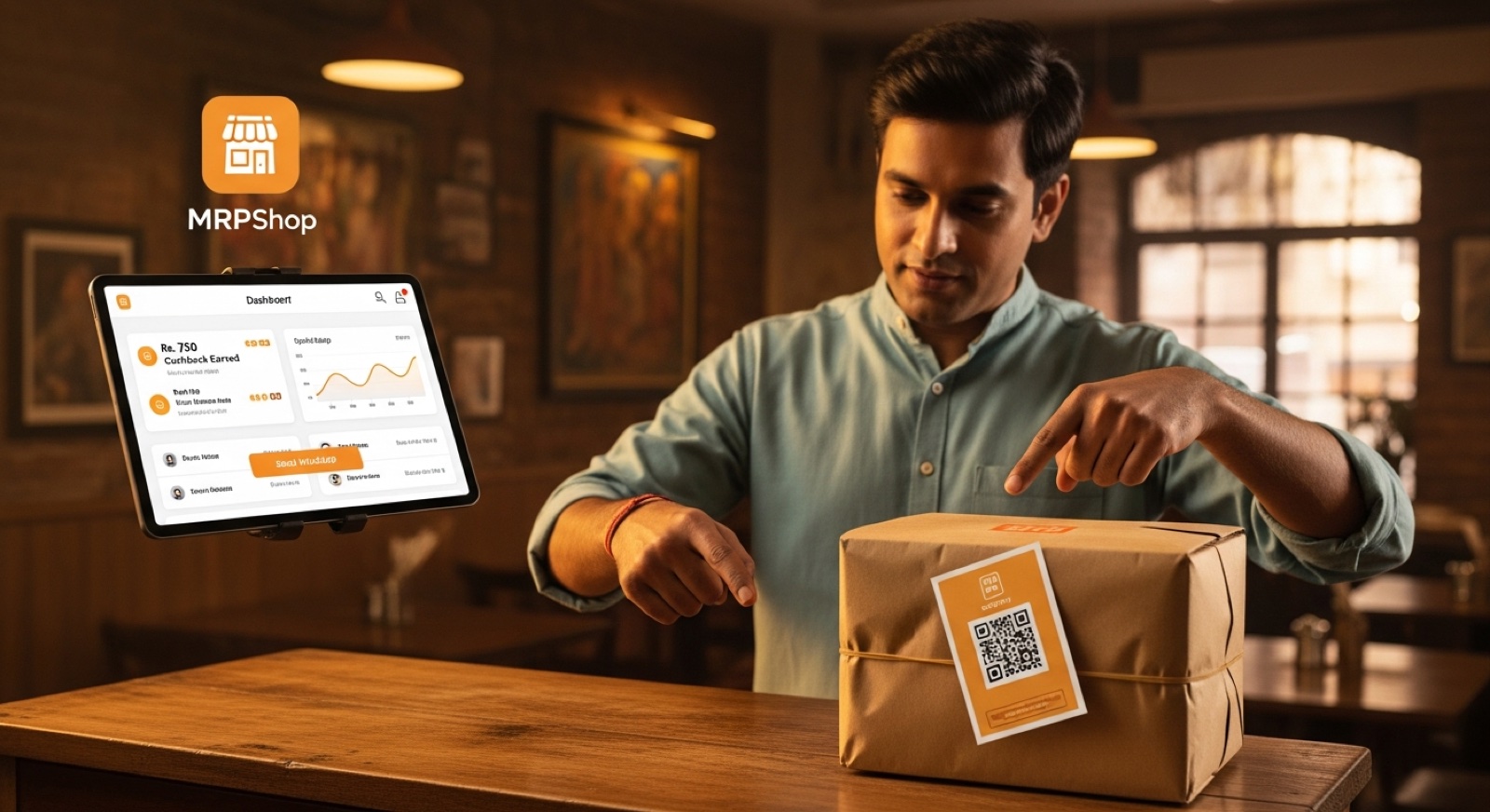
How to Stop Paying 30% Commission to Zomato and Swiggy (Rs.4.3L Exit Playbook)
By Parth · Founder, MRP Shop · Published April 14, 2026 · Updated April 14, 2026
Rs.360 out of every Rs.1,200 Zomato order. That is your AC bill. On 100 delivery orders a month, that is Rs.36,000 you will never see again. In a year? Rs.4.3 lakh - enough to hire a full-time cashier, or pay for your chef and his assistant for almost half the year. And the worst part is not even the money. It is that you still do not own the customer's phone number. They will order from anyone next time. A Bandra bakery owner put it plainly: "Bhai, Zomato se kitchen chalti hai, ghar nahi."
TL;DR - Indian restaurants lose roughly Rs.4.3 lakh per year to Zomato and Swiggy commissions on 100 orders a month. The exit playbook is not to quit aggregators - it is to convert Zomato customers into direct orders via a three-step QR flyer strategy: drop a branded flyer in every delivery bag, offer Rs.200 cashback on the first direct order, and automate WhatsApp follow-ups. Do this for 90 days and direct orders compound to 40%+ of your delivery volume.
How much commission do Zomato and Swiggy actually charge Indian restaurants in 2026?
Zomato and Swiggy charge Indian restaurants roughly 25-30% commission per delivery order in 2026, plus a payment gateway fee of 1.5-2%. On a Rs.1,200 order, the restaurant typically keeps Rs.840 after Rs.360 goes to the aggregator. The exact cut varies by city, cuisine, and ad spend - but 30% is the most common number small restaurants quote.
The math is worth sitting with for a minute. Look at the full picture of one Rs.1,200 order:
| Line item | Amount | Who keeps it |
|---|---|---|
| Customer pays | Rs.1,200 | - |
| Zomato/Swiggy commission (30%) | Rs.360 | Aggregator |
| Payment gateway fee (~2%) | Rs.24 | PG provider |
| Food cost (35% of Rs.1,200) | Rs.420 | Your raw materials |
| Packaging + staff cost (share) | Rs.180 | Your overhead |
| Restaurant keeps | Rs.216 | You |
On a Rs.1,200 ticket you keep about Rs.216. Take away the aggregator commission and you keep Rs.576 - more than 2.5x. That gap is the entire exit playbook in one table.
Why is quitting Zomato the wrong answer?
Quitting Zomato is wrong because Zomato is still the cheapest new-customer discovery channel in India. The goal is to stop depending on Zomato, not to quit it. Use the aggregator to find customers, then convert them into direct repeat orders where you keep the full margin. Most MRP Shop restaurants run both channels in parallel at roughly 60% direct to 40% aggregator.
Think of Zomato as a paid marketing channel. You pay a 30% "finders fee" the first time a customer orders. The question is whether you are willing to pay that fee again on the second, fifth, and tenth order - or whether you want to bring that customer in-house the moment they become a regular.
What is the 6-step exit playbook that actually works?
The 6-step exit playbook starts with a QR flyer in every delivery bag and ends with a full WhatsApp retention loop. No single step is hard. The discipline is doing all six for 90 consecutive days without skipping, because the flywheel only starts compounding after roughly Day 45.
- Print a branded QR flyer that links to your direct storefront. One day to design in Canva, Rs.500 for 500 flyers at any local print shop.
- Drop one flyer in every Zomato and Swiggy delivery bag. This is the single highest-ROI action in the entire playbook and costs you under Rs.1 per order.
- Offer Rs.200 cashback on the first direct order. Automatic via MRP Shop - the customer sees it the moment they scan.
- Send an auto WhatsApp invoice on billing that captures the phone number and unlocks all future follow-ups.
- Trigger a drip campaign on Day 30 for any customer who has not returned. "We miss you" plus a reminder about their unused cashback.
- Route all festival promos (Diwali, Valentine's, Navratri) through the same WhatsApp list. By Diwali next year, the list does the selling for you.
The trap most restaurants fall into is running step 1 but skipping steps 4-6. A flyer without a WhatsApp loop is a leaky funnel - the customer orders once directly, saves Rs.200, and then goes back to Zomato because nothing kept them engaged.
What should the QR flyer in the delivery bag actually look like?
A working QR flyer is the size of a business card, with one headline, one QR code, and one incentive - nothing else. The biggest mistake restaurants make is designing a flyer that looks like a brochure. The customer is opening a biryani at 9:30pm with one hand. They have 3 seconds of attention, and the card must land inside those 3 seconds.
The design brief we hand to restaurant owners is embarrassingly simple:
- Headline (one line): "Order direct next time - Rs.200 off"
- QR code (middle, big): points to your direct storefront URL
- Tagline (bottom): your restaurant name + "No commission. Same kitchen."
- No menu photos, no long text, no terms and conditions. Those go on the storefront, not the flyer.
We have tested 3-panel brochures against single-card flyers in Koramangala. The single card wins by roughly 2.5x on scan rate. The reason is attention: a brochure asks the customer to pause and read. A card asks them to scan. Scanning wins every time.
How does the QR flyer compare to the old way of capturing customers?
The QR flyer beats every other customer-capture method because it reaches the customer in the exact moment they are still eating your food. Flyers in bags convert at 6-10x the rate of Instagram ads, and roughly 4x the rate of paper menus - because the timing is right and the friction is one tap.
| Customer-capture method | Cost per delivery order | Typical scan-to-order rate |
|---|---|---|
| Instagram / Meta ads | Rs.30-80 | 0.5-1.5% |
| Printed menu in bag | Rs.3-5 | 1-2% |
| QR flyer + cashback in bag | Under Rs.1 | 6-10% |
| Google Ads | Rs.40-120 | 1-2% |
The numbers are directional, not audited, but the ranking has been stable across every MRP Shop restaurant we have measured. The QR flyer in the bag wins on both cost and conversion.
How did a Jaipur thali place save Rs.4.3 lakh in one year?
A thali place in Nirman Nagar, Jaipur saved Rs.4.3 lakh across 12 months by running the exit playbook on their 100 monthly Zomato orders. The owner did not quit aggregators, did not hire anyone new, and did not change the menu. He just stopped paying Zomato for customers who would have come back anyway. (composite, typical outcome across Jaipur sellers)
The setup: A 30-seat thali place, breakfast and lunch focus, 100 delivery orders a month via Zomato averaging Rs.1,200 each. Monthly commission outgo: Rs.36,000. Annual outgo: Rs.4.32 lakh. Zero customer phone numbers captured outside Zomato's wall.
Day 1: Owner prints 500 QR flyers at the corner print shop for Rs.480. Sticks a QR flyer into every delivery bag starting the next morning.
Day 12: First direct order comes in via the flyer. Rs.2,500 thali platter, Rs.250 cashback auto-credited. The customer's phone number is now in the owner's WhatsApp list.
Day 45: 18% of delivery orders now come direct. Monthly Zomato commission drops from Rs.36,000 to Rs.29,520.
Day 90: 41% of delivery orders direct. Monthly commission outgo: Rs.21,240. Monthly savings: Rs.14,760.
Annualised savings from Month 4 onward: roughly Rs.14,760 x 12 = Rs.1.77 lakh in the first year alone. By the time the playbook hits Month 9 and direct orders cross 60% of delivery volume, the trailing-twelve-month savings clock in around Rs.4.3 lakh.
Where MRP Shop fits in the exit playbook
We built MRP Shop's aggregator exit stack around exactly this 6-step playbook: the QR flyer storefront, the Rs.200 first-order cashback, the 2-second WhatsApp invoice, the Day 30 drip campaign, and the festival promo engine. It is one reason the average restaurant we onboard sees 40%+ of delivery orders migrate direct inside 90 days. Even if you use a different tool, the principle above works - the automation is what makes 90 consecutive days of flyer-drop plus follow-up actually survivable.
Frequently Asked Questions
How much commission do Zomato and Swiggy actually charge Indian restaurants in 2026?
Zomato and Swiggy charge Indian restaurants roughly 25-30% commission per delivery order in 2026, plus a payment gateway fee of 1.5-2%. On a Rs.1,200 order, the restaurant typically keeps Rs.840 after Rs.360 goes to the aggregator. The exact cut varies by city, cuisine, and ad spend.
Will Zomato penalise my restaurant if I start converting customers to direct ordering?
No. Zomato's terms of service do not prohibit restaurants from running their own loyalty programs or direct channels. Hundreds of Indian restaurants on MRP Shop run both channels in parallel - using Zomato for discovery and direct for retention. The margin mix shifts over time without any contract breach.
How much does it cost to set up a direct ordering channel that actually works?
The upfront cost is effectively zero. You already have a kitchen, staff, and customers. What you need is a digital storefront (free on MRP Shop), printed QR flyers (around Rs.500 for 500 flyers), and a WhatsApp automation tool. The real cost is the 90-day commitment to putting flyers in every delivery bag.
What is the realistic timeline to see meaningful commission savings?
Most restaurants see the first direct repeat customer inside 10-14 days of dropping QR flyers in delivery bags. Meaningful savings (20%+ of delivery orders coming direct) land between Day 45 and Day 60. The full flywheel where 40%+ of delivery orders are direct typically takes 90-120 days to activate.
Can a small restaurant with no tech team run this playbook without breaking things?
Yes. The full setup takes around 15 minutes on a phone or laptop. QR flyers can be designed in Canva. POS integration takes one call with support. Most restaurant owners we onboard in Jaipur, Bandra, and Koramangala had never run a loyalty program before - the playbook is designed for the owner-operator, not a tech team.
Three things to take home
First, every Zomato order is costing you roughly Rs.360 that you will never see again. Second, quitting aggregators is the wrong answer - use them for discovery and convert the customer via a QR flyer in the bag. Third, the savings compound: Month 1 is slow, Month 3 is meaningful, Month 9 is the full Rs.4.3 lakh annualised run rate. The whole playbook is six steps, costs under Rs.500 upfront, and needs about 15 minutes of setup.
P.S. The single most underrated line item in the exit playbook is the Day 30 drip campaign. Restaurants that skip it keep losing roughly one in three direct customers back to Zomato - because the customer forgets the restaurant exists. One WhatsApp message at Day 30 saying "we miss you, your Rs.200 is still waiting" often beats any other retention move we have tested.
Why Indian Restaurants Pick MRP Shop
One platform. Every growth lever. Built for Indian restaurant margins.
Run your own commission-free storefront with MRP Shop.