
The Complete Guide to Restaurant Customer Retention in India (2026)
By Parth · Founder, MRP Shop · Published May 2, 2026 · Updated May 2, 2026
Your Monday customer doesn't come back on Tuesday. You know it. You've counted. Out of every 100 new diners who walk in this month, 75 to 80 will never eat at your place again - not because the dal was bad, but because nothing brought them back. Meanwhile you are spending Rs.36,000 a month on Zomato commissions chasing new faces. The restaurants that win in 2026 are the ones that stop acquiring strangers and start bringing back the ones they already fed.
TL;DR - Retention costs Indian restaurants 5 to 7 times less than acquisition, and a 5 percent lift in repeat rate drives a 25 to 95 percent profit jump. The 2026 playbook: (1) track repeat rate, frequency, LTV, RFM and cohort retention, (2) run 7 automated retention tactics built around WhatsApp cashback as the foundation, (3) let the flywheel compound from Day 30 to Day 15 to Day 7 visit cadence. Most restaurants go from 22 percent to 58 percent repeat rate in 90 days without changing the menu or the price.
- Why retention beats acquisition (the real ROI math)
- The 5 retention metrics Indian restaurants must track
- The 7 retention tactics that actually work in 2026
- The flywheel effect: Day 30 to Day 15 to Day 7
- Acquisition vs retention: side-by-side comparison
- Meera's Jaipur thali place: 19 percent to 62 percent in 90 days
- Common retention mistakes that kill the program
- Retention tools compared
- Where MRP Shop fits
- Frequently Asked Questions
Why does customer retention beat acquisition for Indian restaurants?
Customer retention beats acquisition for Indian restaurants because it costs roughly 5 to 7 times less to bring back an existing customer than to acquire a new one via aggregators or paid ads. A 5 percent lift in repeat rate drives 25 to 95 percent higher profit per location, according to Bain & Company's widely cited loyalty research - and repeat customers spend 20 to 40 percent more per visit.
The math is brutal once you put rupees on it. A new customer via Zomato costs roughly Rs.360 (30 percent commission on a Rs.1,200 order) and the phone number still belongs to Zomato. A new customer via Instagram or Google Ads costs Rs.150 to Rs.400 in ad spend. Bringing back an existing customer via an automated WhatsApp cashback message costs roughly 15 paise per send and converts 3 to 5 times higher.
NRAI puts India's food services market at Rs.4.2 lakh crore - bigger than the entire Indian cement industry. And yet most restaurant owners we talk to have no idea what their 30-day repeat rate is. If you only remember one sentence from this guide: retention is the single metric most Indian restaurants never measure.
"Bhai, Zomato se sirf kitchen chalti hai. Ghar nahi." - a restaurant owner from Bandra, November 2025. He was right. The aggregator pays for the gas. Retention pays for your life.
What are the 5 retention metrics every Indian restaurant should track?
The 5 retention metrics every Indian restaurant should track in 2026 are repeat customer rate, visit frequency, customer lifetime value, RFM segmentation (recency, frequency, monetary), and cohort retention. Together they tell you whether your loyalty program is actually loyal, or just a line item nobody uses. Most restaurants track zero of the five. That ends here.
1. Repeat customer rate (30-day and 90-day)
The percentage of last month's customers who came back within 30 days. Healthy Indian restaurants: 45 to 60 percent. Unautomated restaurants: 15 to 25 percent. Calculate it by pulling unique phone numbers from last month's bills and matching against this month's.
2. Visit frequency (average days between visits)
The average gap between visits for repeat customers. A customer with a good loyalty experience drops from a 45-day gap in Month 1 to 15 days by Month 3 to 7 days by Month 6. Watching this gap shrink is more motivating than any revenue chart.
3. Customer lifetime value (LTV)
Average bill value times visit frequency per year times expected lifespan. A Rs.600 bill, 8 visits a year, 3-year lifespan equals Rs.14,400 LTV. Without LTV you cannot answer retail's most important question: how much can you pay to acquire a new customer?
4. RFM segmentation (recency, frequency, monetary)
Three buckets: Champions (recent, frequent, high spend), Dormant (not seen in 45+ days), New (first visit in last 14 days). Champions get a VIP invite. Dormant get "we miss you". New get an onboarding welcome. One-size-fits-all messaging is why most WhatsApp programs die in Week 3.
5. Cohort retention
Track each month's new customers as a cohort and measure who is still active 1, 3, 6 and 12 months later. If your January cohort is at 50 percent in Month 3 but your March cohort is at 25 percent, something changed in March - find it before April drops to 15.
What are the 7 retention tactics that actually work for Indian restaurants in 2026?
The 7 retention tactics that work for Indian restaurants in 2026 are WhatsApp cashback, Google review automation, referrals, VIP memberships, festival promo automation, 30-day drip campaigns, and the aggregator-to-direct QR flyer strategy. Together they form a flywheel - each reinforces the others. None of them work well alone. All of them work automatically once set up.
1. WhatsApp cashback (the foundation)
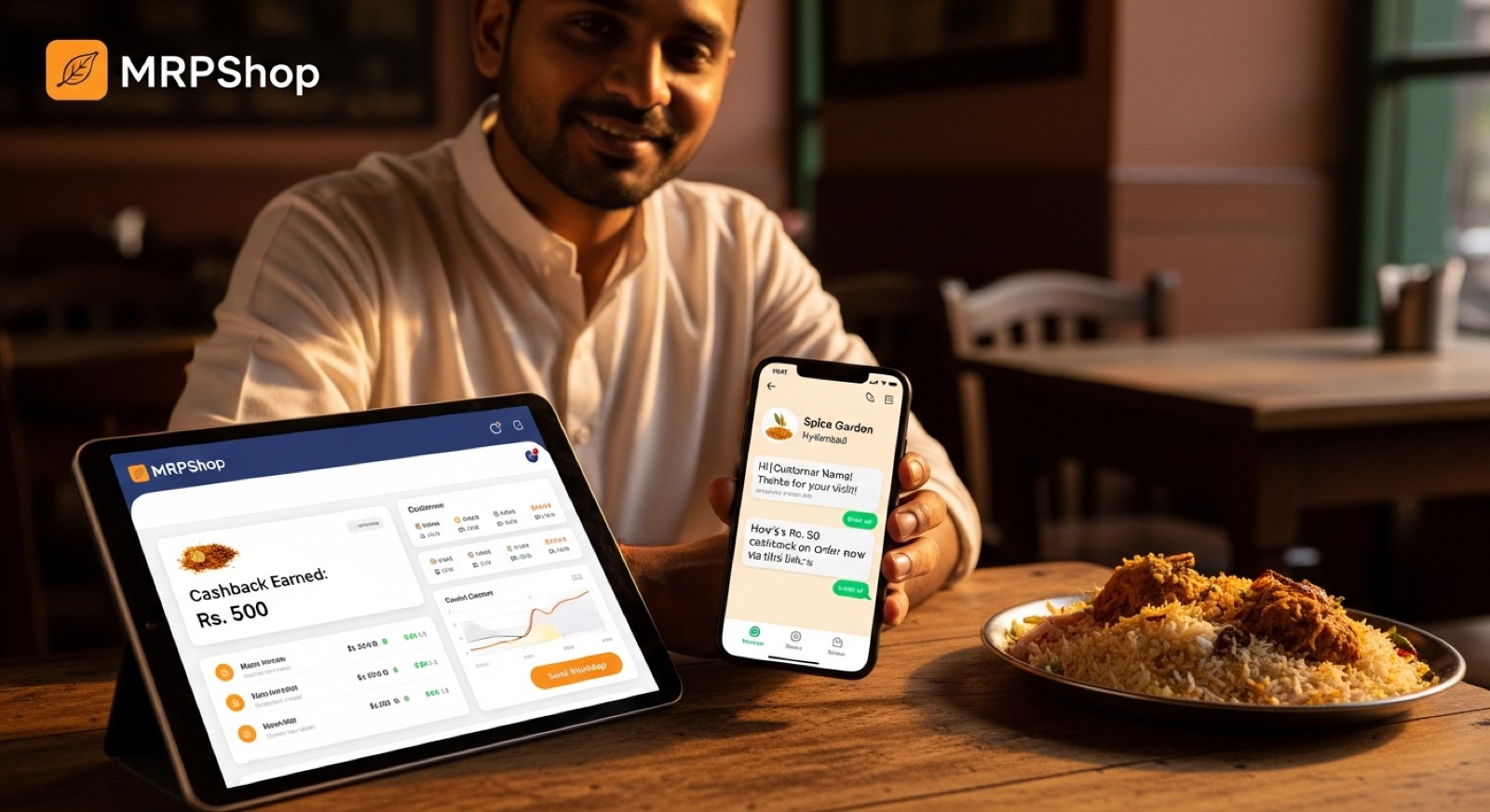
Customer pays Rs.500, phone pings 2 seconds later with the invoice plus Rs.50 cashback redeemable only on the next visit. No points math, no plastic card, no app to download. Rupees hit the phone before the customer hits the parking lot. This is the foundation - every other tactic bolts onto it. If you only do one thing from this guide, do this. Read our WhatsApp cashback setup playbook for the step-by-step.
2. Google review automation
After billing, the customer gets a one-tap link to leave a Google review. No awkward asks at the counter. Restaurants that run review automation typically see their Google rating climb from 3.8 to 4.7 within 90 days, which pulls in organic walk-ins. See our guide to going from 3.8 to 4.7 stars in 90 days.
3. Referral program (Refer & Earn)
Existing customer shares a link on WhatsApp, new customer gets Rs.150 off their first order, referrer gets Rs.150 cashback when the new customer's bill clears. Fully automatic attribution, zero manual tracking. The trick is making both rewards visible in real rupees, not abstract points. Our referral program design guide has the math.
4. VIP membership tiers
Silver, Gold and Platinum tiers with higher cashback rates (7 percent for Silver, 10 percent for Gold, 12 percent for Platinum) plus birthday and anniversary bonuses. VIP tiers create status. Status creates emotional loyalty that survives price changes, new competitors, and even a 3-star review. See how to design VIP tiers for Indian restaurants.
5. Festival promo automation
Diwali, Valentine's, Holi, Navratri, Christmas, Rakhi - all pre-scheduled, all auto-branded with your logo and colors, all sent via WhatsApp template on the festival morning. Your phone sends 847 Diwali cashback offers in 4 seconds while you roll out dough. For the month-by-month plan, read our 2026 restaurant marketing calendar.
6. 30-day drip campaign for dormant customers
Customer hasn't visited in 30 days? A WhatsApp auto-fires: "We miss you! Your Rs.500 cashback is still waiting." No spam, one message, genuine incentive. Roughly 18 to 25 percent of dormant customers return within 14 days. Our drip campaign templates for Indian restaurants has the exact copy.
7. Aggregator-to-direct QR flyer strategy
Drop a branded QR flyer in every Zomato and Swiggy delivery bag. Customer scans, lands on your storefront, orders direct with Rs.200 cashback. You now own the phone number, and the full retention flywheel takes over. Roughly 8 percent of aggregator customers convert within 30 days. Read the full aggregator conversion playbook.
How does the retention flywheel actually compound over 90 days?
The retention flywheel compounds because each visit shrinks the gap to the next one. A new customer who gets WhatsApp cashback plus a festival promo comes back in 30 days. The second visit earns more cashback plus a review request, so they come back in 15 days. By visit 4 they are back every 7 days - not because you asked, but because the rupees are waiting on their phone.
Here is what the real sequence looks like for a typical Indian restaurant that turns on MRP Shop on Day 0:
- Day 1: Customer pays Rs.500, phone pings in 2 seconds with invoice and Rs.50 cashback.
- Day 1 + 30 min: One-tap Google review request lands - customer taps 5 stars from the auto.
- Day 30: No return visit triggers a drip WhatsApp ("Your Rs.50 is still waiting").
- Day 32: Customer returns, bills Rs.650, redeems Rs.50, earns Rs.65 new cashback.
- Day 47: Diwali festival promo fires automatically - 10 percent bonus that weekend.
- Day 48: Customer returns for Diwali dinner, bills Rs.1,200, earns Rs.180 total.
- Day 55: Silver VIP unlocked (3 visits in 60 days). They tell their sister.
- Day 62: Sister walks in through a referral link - Rs.150 off her first order, you earn a new phone number.
- Day 75: Customer visits again - gap between visits is now 13 days, down from 30.
- Day 90: Your monthly repeat rate is 58 percent, up from 22 percent.
None of this requires you to touch the phone. The flywheel runs on its own once set up - because Indian restaurant owners do not have time to run marketing. Our full flywheel math guide has the 180-day version.
How does acquisition stack up against retention - side by side?
Acquisition and retention are not opposites, but the cost and compounding mechanics differ drastically. Acquisition is linear - you spend Rs.X and get one customer. Retention is exponential - you spend Rs.Y once and the same customer returns 6 to 12 times. The table below breaks down the real unit economics for an Indian restaurant doing 100 deliveries a month.
| Factor | Acquisition (Zomato / Ads) | Retention (MRP Shop style) |
|---|---|---|
| Cost per customer | Rs.200 to Rs.400 (ad or commission) | Rs.0.15 per WhatsApp + 10% cashback |
| Customer phone number | Hidden (Zomato owns it) | Yours |
| Expected visits per year | 1 to 1.5 (mostly one-time) | 6 to 12 (flywheel active) |
| Compounding effect | None (pay again next time) | Grows with each visit |
| Word of mouth | Low (no relationship) | High (reviews + referrals) |
| Profit margin per customer | Shrinking (30% commission) | Growing (full bill kept) |
| Manual effort | High (list building, ad tweaking) | Zero after 15-min setup |
The uncomfortable truth: most Indian restaurants spend 80 percent of their marketing budget on acquisition and 20 on retention. The math says flip the ratio.
How Meera's Jaipur thali place went from 19 percent to 62 percent repeat rate in 90 days
Meera Sharma runs Rajasthani Rasoi in Nirman Nagar, Jaipur - 28 seats, family-run thali place, 140 bills a day. When we first met her in January 2026, her 30-day repeat rate was 19 percent and her Google rating had been stuck at 3.9 for ten months. She was losing Rs.22,000 a month to Swiggy commissions and had no idea who her regulars were.
The problem. Meera had tried manual WhatsApp blasts, a stamp card nobody used, and a 10-percent-off Wednesday that just ate margin. "Main har hafte list banati hoon," she told us, "phir bhi customer wapas nahi aata."
What changed. On Day 0 she set up MRP Shop in 15 minutes while her dal simmered. WhatsApp cashback at 10 percent, Google review automation, Diwali and Holi promos pre-scheduled, a 30-day drip, and a QR flyer for Swiggy bags (500 flyers from Canva for Rs.600).
90 days later.
- Repeat customer rate: 19 percent to 62 percent
- Google rating: 3.9 to 4.7 (reviews per month: 6 to 38)
- Average visit gap for repeat customers: 42 days to 11 days
- Monthly dine-in revenue: up 34 percent (same menu, same price, same seats)
- Swiggy-to-direct conversions: 11 customers in Month 2 - saving Rs.3,960 in commissions on their combined repeat orders
"Pehle main customers ke peeche bhaagti thi. Abhi customer apne aap aata hai - aur thoda naya friend bhi le aata hai." - Meera Sharma, Rajasthani Rasoi, Jaipur. The automation did not change her food. It changed who came back to eat it.
(composite, Meera's story is based on patterns across 40+ Jaipur sellers on MRP Shop. Not a single named restaurant. Numbers are representative.)
What are the most common retention mistakes that kill Indian restaurant loyalty programs?
The most common retention mistakes Indian restaurants make in 2026 are running discounts instead of cashback, making cashback expire too fast, not automating the WhatsApp follow-up, ignoring dormant customers, and treating all customers the same. Each mistake is fatal alone - most restaurants make 3 or 4 at once, then conclude that "loyalty does not work in India." It works. The execution doesn't.
Mistake 1: Discounts instead of cashback
"20 percent off Wednesdays" trains customers to wait for Wednesday. Rs.50 cashback trains them to come back for the rupees. The first eats margin every visit. The second only costs you on the return visit - which is the visit you were paying to cause.
Mistake 2: Expiry windows under 30 days
If cashback expires in 7 days, most customers never use it - they don't plan that tight. 30 to 45 days is the sweet spot: long enough to feel ownership, short enough to create urgency. Under 14 days feels like a trick.
Mistake 3: Manual WhatsApp blasts
Every manual loyalty program dies in Week 3. The owner is tired, the phone is full of unread replies, the Diwali blast went out two days late. Automation is the difference between a program that survives and one that collapses.
Mistake 4: Ignoring dormant customers
Most restaurants spend 90 percent of their retention effort on the 10 percent already coming back, and zero on the 90 percent who have gone quiet. Backwards. The highest-ROI message you'll ever send is "we miss you" to a customer last seen 45 days ago.
Mistake 5: One-size-fits-all messaging
A champion gets the same message as a first-timer, who gets the same message as a dormant customer. All three unsubscribe within a month. RFM segmentation - three buckets, three messages - is the cheapest fix in this guide.
Which restaurant retention tools should Indian SMBs compare in 2026?
Indian restaurant retention tools in 2026 fall into four categories: dedicated loyalty platforms, WhatsApp marketing tools, POS-native marketing modules, and all-in-one restaurant growth platforms. Each category trades depth for breadth. The right pick depends on whether you already have a POS and how much manual work you can absorb.
| Tool category | Strength | Weakness | Best for |
|---|---|---|---|
| Dedicated loyalty (Reelo, Hashtag) | Deep cashback and points mechanics | Weak WhatsApp + no review automation | Chains with existing POS |
| WhatsApp-only tools | Cheap broadcast messaging | No billing integration, manual loyalty | Cloud kitchens testing the waters |
| POS-native modules (Petpooja, POSist) | Built-in billing link | Thin retention features, no drip logic | Restaurants who want minimum vendors |
| All-in-one growth (MRP Shop) | Loyalty + WhatsApp + reviews + referrals + VIP + festival auto, single POS plug | Newer player vs legacy brands | Indian SMB restaurants who want retention to run itself |
The question is not "which tool is best" - it is "which tool covers the 7 tactics above with zero manual effort". Any tool that forces you to manually craft the Diwali message will fail within a quarter. See our MRP Shop vs Reelo comparison for a deeper breakdown.
Where does MRP Shop fit in the retention stack?
We built MRP Shop as the all-in-one automation layer for the exact 7 tactics above - WhatsApp cashback, Google review automation, referrals, VIP tiers, festival autosend, 30-day drip, and aggregator-to-direct QR conversion - plugged into Petpooja and other Indian POS systems. 1,000+ restaurants run it today, and our average seller moves from roughly 22 percent repeat rate to 58 percent inside 90 days. We are a Meta Solution Partner, so the WhatsApp side is compliant. Even if you build your own stack from 4 separate tools, the playbook in this guide is what matters - MRP Shop just makes it survivable.
Frequently Asked Questions
What is customer retention for restaurants and why does it matter in India?
Customer retention is the share of existing customers who return within a defined window, typically 30 to 90 days. For Indian restaurants, retention matters because acquiring a new customer via Zomato, Swiggy or Instagram ads costs roughly 5 to 7 times more than bringing back a Monday walk-in, and repeat customers spend 20 to 40 percent more per visit.
What is a healthy repeat customer rate for an Indian restaurant?
A healthy repeat customer rate for an Indian dine-in or QSR is 45 to 60 percent within 90 days. Most unautomated restaurants sit at 15 to 25 percent. Restaurants that run WhatsApp cashback plus review automation typically move from the low 20s to the high 50s within a single quarter, without increasing ad spend.
How do I calculate customer lifetime value for a small Indian restaurant?
Multiply average order value by visit frequency per year by expected customer lifespan in years. A Rs.600 average bill, 8 visits per year, and a 3-year lifespan equals Rs.14,400 lifetime value. Track it using phone numbers captured via WhatsApp invoicing - aggregator-only restaurants cannot compute this because the customer data lives with Zomato or Swiggy.
What is the single highest-ROI retention tactic for 2026?
Automated WhatsApp cashback within 2 seconds of billing. It captures the customer phone number, drops a rupee-denominated reason to return, and removes all manual effort from the owner. Every other tactic - reviews, referrals, festival promos - compounds on top of this foundation, but none replace it.
How long does it take to see meaningful retention results in an Indian restaurant?
Most Indian restaurants see their first repeat cashback redemption within 10 to 14 days of launching a loyalty program. Meaningful lift - 40 percent repeat rate or higher - lands between Day 45 and Day 60. The full flywheel, where 60 percent of monthly revenue comes from repeat customers, takes 90 to 120 days of consistent automation.
Should I offer cashback or points for a restaurant loyalty program?
Cashback denominated in rupees, not points. Indian customers parse Rs.500 instantly - 500 points requires math. Cashback programs see 40 to 50 percent redemption rates for Indian SMB restaurants, while points programs sit at 12 to 15 percent industry-wide. Cashback also forces a return visit because redemption is only valid on the next bill.
Can I retain customers acquired through Zomato or Swiggy aggregators?
Yes, but only by capturing the customer outside the aggregator wall. Drop a branded QR flyer in every delivery bag offering Rs.200 cashback on the first direct order. Roughly 8 percent of aggregator customers will scan and order direct within 30 days. From there, standard retention automation (WhatsApp, cashback, reviews) takes over.
What mistakes kill retention programs before they start working?
Three mistakes: making cashback expire too fast (under 30 days kills redemption), running discounts instead of cashback (discounts train customers to wait, cashback trains them to come back), and not automating the follow-up message. Manual WhatsApp blasts fail within 3 weeks because the owner runs out of time. Automation is non-negotiable.
Three things to take home
First, retention is 5 to 7 times cheaper than acquisition, and a 5 percent lift in repeat rate grows profit by 25 to 95 percent. Second, the 7 tactics only work as a system - WhatsApp cashback is the foundation and automation keeps them alive past Week 3. Third, the flywheel is real and measurable - visit gaps shrink from 30 days to 15 to 7 inside 90 days when the loop is running.
For the next step, read our 2026 restaurant marketing calendar to line up every festival campaign for the year, our WhatsApp cashback setup playbook for the step-by-step launch, and our aggregator conversion playbook to pull your Swiggy customers onto direct. When you are ready, book a 15-minute WhatsApp demo and we will walk through the cashback math on your own numbers - no sales pitch.
P.S. The single highest-ROI move we have ever seen an Indian restaurant make is not a loyalty program - it is turning on the 30-day drip campaign. A single automated "we miss you" WhatsApp to customers who haven't visited in 45 days brings back 18 to 25 percent of them within two weeks. It's the closest thing to free money in this entire guide.
Why Indian Restaurants Pick MRP Shop
One platform. Every growth lever. Built for Indian restaurant margins.
The complete retention toolkit. Set up in 15 minutes.